




248 Pages
by
Routledge
248 Pages
by
Routledge
248 Pages
by
Routledge
Also available as eBook on:
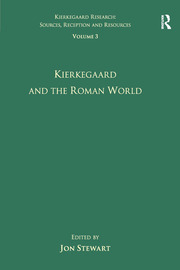
While Kierkegaard's use of the Greek authors, particularly Plato and Aristotle, has attracted considerable attention over the years, his use of the Roman authors has, by contrast, remained sadly neglected. This neglect is somewhat surprising given the fact that Kierkegaard was extremely well read in Latin from his early youth when he attended the Borgerdyd School in Copenhagen. Kierkegaard's... Read more
Contents: Preface; Apuleius: direct and possible indirect influences on the thought of Kierkegaard, Stacey E. Ake; Cicero: a handy Roman companion: Marcus Tullius Cicero's appearance in Kierkegaard's works, Thomas Eske Rasmussen; Horace: the art of poetry and the search for the good life, Thomas Miles; Livy: The History of Rome in Kierkegaard's works, Nataliya Vorobyova; Marcus Aurelius: Kierkegaard's use and abuse of the stoic emperor, Rick Anthony Furtak; Nepos: traces of Kierkegaard's use of an edifying Roman biographer, Jon Stewart; Ovid: of love and exile: Kierkegaard's appropriation of Ovid, Steven P. Sondrup; Sallust: Kierkegaard's scarce use of a great Roman historian, Niels W. Bruun; Seneca: Disjecta Membra in Kierkegaard's writings, Niels W. Brunn; Suetonius: exemplars of truth and madness: Kierkegaard's proverbial uses of Suetonius' Lives, Sebastian Høeg Gulmann; Tacitus: Christianity as odium generis humani, Jon Stewart; Terence: traces of Roman comedy in Kierkegaard's writings, Mikkel Larsen; Valerius Maximus: moral Exempla in Kierkegaard's writings, Nataliya Vorobyova; Virgil: from farms to empire: Kierkegaard's understanding of a Roman poet, Steven P. Sondrup; Indexes.
Biography
Jon Stewart is an Associate Research Professor in the Søren Kierkegaard Research Centre at the University of Copenhagen, Denmark.
