




1st Edition
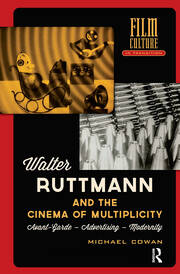
Walter Ruttmann and the Cinema of Multiplicity Avant-Garde Film - Advertising - Modernity
By Michael Cowan
Copyright 2014
260 Pages
by
Routledge
260 Pages
by
Routledge
260 Pages
by
Routledge
Also available as eBook on:
A key figure in early avant-garde cinema, Walter Ruttmann was a pioneer of experimental animation and the creative force behind one of the silent era's most celebrated montage films, Berlin: Symphony of a Great City . Yet even as he was making experimental films, Ruttmann had a day job. He worked regularly in advertising -and he would go on to make industrial films, medical films, and even Nazi... Read more
Introduction: Avant-Garde, Advertising and the Managing of Multiplicity 1. Absolute Advertising: Abstraction and Figuration in Ruttmann’s Animated Product Advertisements (1922-1927) 2. The Cross-Section: Images of theWorld and Contingency Management in Ruttmann’s Montage Films of the Late 1920s (1927-1929) 3. Statistics and Biopolitics: Conceiving the National Body in Ruttmann’s Hygiene Films (1930-1933) 4. ŸÜberall StahlŒ: Forming the New Nation in Ruttmann’s Steel and Armament Films (1934-1940) Afterword: Of Good and Bad Objects, Notes, Bibliography, Filmograph, Index of Names, Index of Film Titles, Index of Subjects.
Biography
Michael Cowan is Professor of film and media history in the Department of Cinematic Arts at the University of Iowa. His research, focused on German and European cinema, examines the broader cultural and technological contexts in which film practices emerged and evolved in the early 20th century. His publications have won numerous awards from the Society of Film and Media Studies and the British Association of Film and Television Studies Scholars, as well as the Willy Haas Award (Germany) and the Limina Award (Italy).
