





1st Edition
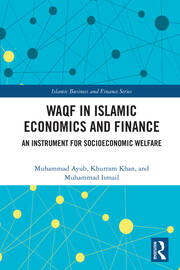
Waqf in Islamic Economics and Finance An Instrument for Socioeconomic Welfare
234 Pages
18 B/W Illustrations
by
Routledge
234 Pages
18 B/W Illustrations
by
Routledge
234 Pages
18 B/W Illustrations
by
Routledge
Also available as eBook on:
Waqf is emerging globally as a distinctive institution, serving as a vital bridge between societal and economic needs, and resource allocation. Waqfs functioning in some parts of the world, of a variety of assets such as cash, stocks, securities, intellectual property rights, and other financial instruments by individual, institutional, and corporate wāqifs , are paving the way for financial... Read more
1. Introduction and historical perspective of Waqf 2. The evolution of Waqf as an Institution for Socio-Economic Growth 3. Promoting entrepreneurship through the system of Awqāf 4. Waqf for accelerating socio-economic development 5. Waqf Based Financial Inter-mediation, FinTech and crowdfunding for realizing the potential of Islamic Social Finance 6. Management and Governance of Awqāf as Social Finance Institutions 7. Waqf Based Legal and Organizational Frameworks 8. Realizing the potential of Waqf for shared growth and sustainable socio-economic development
Biography
Muhammad Ayub is Professor of Islamic Economics and Finance, Riphah Center of Islamic Business, Riphah International University, Islamabad, Pakistan.
Khurram Khan is Professor of Management and Finance at the the Faculty of Management Sciences, Riphah International University, Islamabad, Pakistan.
Muhammad Ismail is Assistant Professor of Finance and Islamic Finance, Iqra National University, Peshawar, Pakistan.
