




532 Pages
by
Routledge
532 Pages
by
Routledge
532 Pages
by
Routledge
Also available as eBook on:
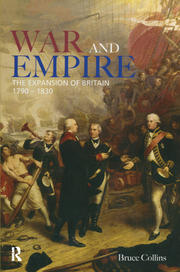
The years 1790 to 1830 saw Britain engage in an extensive period of war-waging and empire-building which transformed its position as an imperial state, established its reputation as a distinctive military power and secured naval preeminence.
Despite this apparent success, Britain did not become a world super power in the conventional sense. Instead, as Professor Collins demonstrates, it... Read more
Preface and Acknowledgements Maps Part One: War, empire and British identity Chapter 1: War and empire: the contested connection Chapter 2: Britain's militarism Part Two: The War against Republican France Chapter 3: Containing France in Europe, 1793-95 Chapter 4: The expanded contest, 1793-97 Chapter 5: The Irish rebellion, 1796-98 Chapter 6: Renewing alliances and positioning for peace, 1798-1801 Part 3: Military imperialism in India Chapter 7: IndiaMilitary efficiency and Mysore, 1790-92 Chapter 8: Imperial expansionism and Mysore, 1798-99 Chapter 9: Expansionism against the Marathas, 1803-05 Part 4: The War against Napoleon Chapter 10: The quest for objectives, 1803-08 Chapter 11: The Iberian Peninsular commitment, 1808-13 Chapter 12: Victory in Spain and France, 1813-14 Part 5: Britain's global reach Chapter 13: The war of 1812 Chapter 14: The Waterloo campaign: lessons learned? Chapter 15: Completing British paramountcy in India, 1814-19 Part 6 The impact of war Chapter 16: Instruments of power Chapter 17: Aristocracy and British military culture Chapter 18: Interventions overseas, 1820-1830 Chapter 19: Britain as a global power, 1815-30 Index
Biography
Bruce Collins is Professor of Modern History at Sheffield Hallam University.
‘This is an admirable survey - comprehensive, clear and readable.’
Brian Holden Reid, Kings College London
