




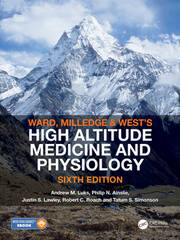
6th Edition
Ward, Milledge and West’s High Altitude Medicine and Physiology
Foreword
Acknowledgments
1. History of high altitude medicine and physiology
SECTION I. THE ENVIRONMENT AND ITS PEOPLE
2. The atmosphere
3. Geography
4. High altitude residents
5. Travelers and workers at high altitude
6. Genetics and genomics of exposure to high altitude
SECTION II. PHYSIOLOGIC RESPONSES TO HYPOXIA
7. Acclimatization
8. Pulmonary gas exchange
9. Control of breathing
10. Oxygen affinity and acid–base balance
11. Cardiovascular system
12. Central nervous system
13. Hematologic responses
14. Peripheral tissues
15. Energy balance and metabolism
16. Endocrine and metabolism
17. Sleep
18. Exercise
19. Physiology of extreme altitude
SECTION III. CLINICAL HIGH ALTITUDE MEDICINE
20. Acute mountain sickness
21. High altitude cerebral edema
22. High altitude pulmonary edema
23. Other medical conditions that occur at high altitude
24. Chronic altitude illness
25. High altitude travel with preexisting medical conditions
26. Children, the elderly, and women at high altitude
27. Other environmental illnesses in the mountains
Index
Biography
Andrew Luks is a Professor at the Division of Pulmonary, Critical Care & Sleep Medicine, Harborview Medical Center, The University of Washington, Seattle, USA
Phillip Ainslie is a Professor at the School of Health & Exercise Sciences and Co-Director, Centre for Heart, Lung & Vascular Health, The University of British Columbia, Okanagan, Canada
Justin Lawley is a Professor at the Institute for Sports Science, University of Innsbruck, Innsbruck, Austria
Robert Roach is an Associate Professor, Altitude Research Center, Division of Pulmonary Sciences & Critical Care, Anschutz Medical Campus, University of Colorado, Denver, USA
Tatum Simonson is an Assistant Professor, Division of Pulmonary, Critical Care & Sleep Medicine and Co-Director, Center for Physiological Genomics of Low Oxygen, University of California, San Diego School of Medicine, USA
