





1st Edition
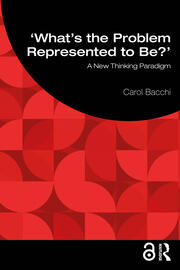
What's the Problem Represented to Be? A New Thinking Paradigm
Introduction: A new thinking paradigm—beyond problem-solving; Part I: Introducing a WPR Approach 1. Initiating a WPR Analysis: key premises 2. Widening the scope of application 3. Troubling ‘problems’: Challenges for researchers; Part II: Theoretical Elaborations 4. What is a ‘subject’? Who is a ‘subject’? 5. The turn to ‘practice’: What are ‘practices’? 6. Moving from ‘being reflexive’ to practising ‘self’-problematisation 7. Governmentality and WPR: Exploring governing practices 8. Cultivating a genealogical sensibility 9. The politics of change: ‘Resistance’, ‘counter-conducts’ and ‘subjugated knowledges’; Part III: Theoretical Engagements 10. Strategic interventions: Feminisms, problem representations and gendering practices; 11. Analysing differencing practices: Racialising, colonising, disabling, heteronorming, classing, caste-ing; 12. Problematising (in) a material world: Empiricism, description, affectivity and social flesh; 13. Critical questions: From ‘ideology critique’ to ‘postcritique’; 14. Questioning performativity: What’s at stake?; Part IV: The Thorny Issue of ‘Mixed Methods’ 15. Problematising (with) paradigms: ‘Reality’, ‘problems’ and ‘mixed methods’; 16. Analysing discourse/s as knowledge practices; 17. How to deal with ‘data’; 18. The use of ethnography; Part V: WPR and Governing in the Time of COVID-19 19. ‘Governing through experimenting’: A political rationality; 20. Researching a pandemic; 21. Applying WPR to concepts: Questioning ‘risk’, ‘crisis’ and ‘uncertainty’; 22. Making mortality ‘social’: How death certificates undermine the social determinants of health; Conclusion: Why we need a new thinking paradigm
Biography
Carol Bacchi is Professor Emerita of Politics, Adelaide University, Australia. She researches and writes in the fields of politics, policy theory and feminists’ theories.
