




1st Edition
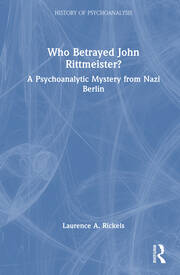
Who Betrayed John Rittmeister? A Psychoanalytic Mystery from Nazi Berlin
Introduction
Part One: Who Betrayed JR?
1 The Boys from Brazil
2 A Peculiar Form of Resistance
3 Besserman Vianna and Rittmeister
4 Gejungt
5 Into the Frying Pan
6 Captive Analysis and the Specifics of the Transference
Part Two: Acquitting WK
1 Happy Kemper
2 Schweigen and Giving Them the Slips
3 Hard on the Trail of the Missing
4 The Transferential Imperative and Homosexuality as Resistance
5 Lady MacKemper
Part Three: The Colleagues at the Göring Institute
1 B&B
2 Forays
3 Rose
4 Comrade Dräger
5 Child Analysis Begins in the Home of the Analyst
6 Fitness Regimens
Part Four: The Author of JR's Demise
1 Whose Language Was It?
2 Le code postal
3 The Session
4 The End of Navel Gazing: Delinquency and GDR Socialism in Outer Space
5 Counterfeit Selves
6 The Ghost Goes Knax in Hessenwinkel
7 Man in a Can
8 Don Quixote and Nazi Literature in Kathy Acker and Robert Bolaño
Biography
Laurence A. Rickels analyses the condition of "unmourning" in literature, film, philosophy and psychoanalysis across his collected work of 15 publications, beginning with Aberrations of Mourning (1988). He dislodged this concept from the traditional opposition between successful mourning and melancholia. Psychoanalysis, the Frankfurt School, and deconstruction inform his perspective.
“Laurence Rickels has been a guiding beacon for me for two decades now. Nobody thinks the intersection of media and mourning better, or more lucidly argues for the place of trauma at the centre of our understanding of history and the arts.” - Tom McCarthy
“This book widens the understanding of the complex and contradictory motives of psychoanalysts and scientists remaining in Nazi Germany and being forced to cope with it.” - Ludger Hermanns, Psychoanalyst in private practice in Berlin and member of the Karl Abraham Institute
“On 13 May 1943, the neurologist and psychoanalyst John Rittmeister was beheaded by the Nazis in Plötzensee Prison in Berlin following charges of high treason and favouring the enemy. His resistance and fate made him something of an icon in the post-war reconstruction of psychoanalysis in Germany. His story was complex, historically, politically, and ethically. Left leaning, Rittmeiseter had been affiliated with both the notorious Göring Institute and the anti-fascist resistance group Rote Kapelle (Red Orchestra). In exploring Rittmeister’s fate, Laurence Rickels, the acclaimed historian of psychoanalysis in Nazi Germany, reopens this ‘cold case’, challenges previous reconstructions of the events, and offers new insights into his betrayal. In doing so, Rickels also reveals hitherto largely hidden sequelae of these events in a scandal in Brasil involving analytic training, torture, and the transmission of unacknowledged Nazi legacies. Building on close readings of archival research, clinical writings, postwar institutional histories, and literary fiction, Rickels has produced a nuanced work that is both a significant contribution to psychoanalytic history and at the same time a gripping detective / true crime page turner.” - Roger Willoughby, Oxford Brookes University, clinical psychologist and historian of psychoanalysis, Gradiva Award winner, author of Masud Khan: The Myth and the Reality (2005) and Freud’s British Family: Reclaiming Lost Lives in Manchester and London (2024), and co-editor of historiesofpsychoanalysis.com
