




1st Edition
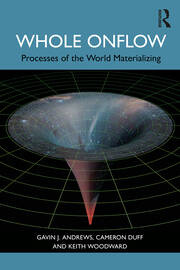
Whole Onflow Processes of the World Materializing
1. Whole Onflow As All Emergence: An Introduction 2. Beyond The 'Great Planes': The Qualities And Capacities Of Whole Onflow 3. The Ontological Primacy Of Flows: The Emergence Of Events And Objects 4. Whole Onflow And Non-Representational Theory: Reciprocal Relations 5. Experience As The Event Of Actualization From Whole Onflow 6. World Reimagined: The World And Life Worlds In Whole Onflow 7. Aging Reimagined: A 'Gero Of All Things' And The Co-Agings In Whole Onflow 8. Health Reimagined: The Healths Of All Things In Whole Onflow 9. Capitalism Reimaged: The New Capitalism In Whole Onflow
Biography
Gavin J. Andrews is Professor in the Department of Health, Aging and Society at McMaster University in Ontario, Canada. He is also Associate Member of the School of Earth, Environment and Society at the same institution. Andrews is a human geographer with wide-ranging interests, particularly around issues of health and well-being. Much of his work is positional and considers the development, state-of-the-art and future of health and social geography. He is interested in fundamental ontological questions, drawing on posthumanist, new materialist and non-representational theory to answer those questions, to animate the emergence and vitality of the social world and to explain the compositions, processes and textures of space involved.
Cameron Duff is Professor of Political Science at the Centre for Organisations and Social Change in the College of Business and Law at RMIT University in Melbourne, Australia. Duff’s programme of research explores the role of social innovation in driving social change in the community and not-for-profit sectors, with a focus on mental health care and social housing. Working at the intersection of political and organizational theory, Duff’s scholarship advances theoretical accounts of the ways social innovations emerge in response to complex social problems in urban settings, informed by close readings of the work of Gilles Deleuze, Elizabeth Grosz, Judith Butler, Manuel DeLanda, Bruno Latour and Michel Foucault.
Keith Woodward is Professor of Social Theory and Director of the School of Geography, Development, and Environment at the University of Arizona, the United States. He works at the intersections of affect theory, social and spatial theory, continental philosophy and social struggles. His early work helped to spark the so-called 'scale debates' in geography, and his contributions to site ontology form a key element in the discipline's ontological turn. He is interested in the work of Deleuze, Simondon, Badiou and others and is currently writing a monograph on Jean Genet and mereology.
