




1st Edition
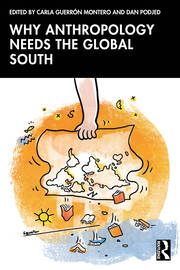
Why Anthropology Needs the Global South
List of Figures
List of Contributors
Foreword: Being Human in an Increasingly Crowded Place - Hebe Vessuri
1. Turning the Compass, Flipping the Map - Carla Guerrón Montero and Dan Podjed
2. Mending the World Together: An Anthropological Guide to Collective Care - Bo Kyeong Seo
3. Anthropologies of Conservation in the Global South - Francisco Araos, Wladimir Riquelme, Florencia Diestre, Ricardo Álvarez, and Victor Sousa
4. Sensing the Sea for an Anthropology of the Global South - Rosabelle Boswell
5. A Truly Global South, or Why Anthropology Needs Anthropologies of the Global South - Rosana Guber
6. Development and the Responsible Ethnographer - Gayathri Sreedharan
7. Toward Repair Anthropology - Samwel Moses Ntapanta
8. Ethnographies Beyond Borders - Ethni Amsale and Liliana Rafoth
9. The Global South as an Equal Partner - Dan Podjed and Carla Guerrón Montero
Index
Biography
Carla Guerrón Montero is an applied cultural anthropologist working on world anthropologies, the anthropology of tourism, and the anthropology of food in the African diaspora. She is Professor of Anthropology and Director of the Center for Material Culture Studies (CMCS) at the University of Delaware. Guerrón Montero is the author of several books, including From Temporary Migrants to Permanent Attractions: Tourism, Cultural Heritage, and Afro-Antillean Identities in Panama (2020), its Spanish translation (2023), and the coauthored The Origins of Prejudice (2026). She is co-editor of the award-winning Why the World Needs Anthropologists (Routledge, 2021, 2026). Guerrón Montero is a long-standing member of the EASA Applied Anthropology Network (AAN) and currently serves as its co-convenor through 2028.
Dan Podjed is an applied anthropologist from Slovenia whose work explores isolation, crises, human–technology interaction, and sustainable ways of living. He is a senior research fellow at the Research Center of the Slovenian Academy of Sciences and Arts, a professorat the University of Ljubljana’s Faculty of Arts, and a field expert at the Institute for Innovation and Development of the University of Ljubljana. He is the founder of the EASA AAN and the initiator of the international event Why the World Needs Anthropologists, organized annually since 2013. Podjed is the author of several books written for both academic and general audiences, a frequent public speaker, and a regular contributor to media discussions on social and technological change. The Slovenian Science Foundation named him 2024 Science Communicator of the Year for his public science outreach.
"The history of hegemonic global knowledge production and circulation is plagued by the selective appropriation and suppression or distortion of other people’s knowledge. These imperialist and colonialist processes resulted in the loss of an unimaginable amount of heuristic power. This book is a most stimulating addition to the longstanding cognitive struggle against the arrogance of metropolitan provincialism and the ignorance that sustains it. Exploring these issues is especially important in anthropology, a discipline that celebrates diversity but still has a long way to go to benefit from its global heterogeneity and move beyond North Atlanticentrism."
- Gustavo Lins Ribeiro, Universidad Autónoma Metropolitana-Lerma (México)
"This book proposes a decisive shift in the anthropological perspective: moving beyond the conception of the Global South as a mere space for data production and recognizing it as a central site for theoretical, methodological, and ethical development. Through situated ethnographies, critical reflections, and collaborative research experiences addressing themes such as global health, as well as collective care, conservation, and reparation practices, the work demonstrates how anthropologies of the Global South challenge the epistemic hierarchies inherited from colonialism and enrich contemporary debates within the discipline. Thus, by emphasizing that the future of anthropology depends on embracing its pluralistic and polycentric nature, the book offers a key contribution to discussions on the decolonization of knowledge."
- Claudia Salomón Tarquini, State Director of Cultural Heritage of La Pampa; Professor at the National University of La Pampa (Argentina)
