




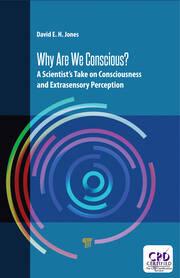
1st Edition
Why Are We Conscious? A Scientist’s Take on Consciousness and Extrasensory Perception
Introduction
The Physical World
Life and Its Information
The Unconscious Mind
Methods in Physical Science: Feelings Don’t Matter
Methods in Paranormal Science: Feelings Do Matter
The Physical Properties of the Unknown World Outside Our Diving Bell
Physical Effects of the Unconscious Mind and the Unknown World 1
Observed Effects of the Unconscious Mind and the Unknown World 2
Observed Effects of the Unconscious Mind and the Unknown World 3
Observed Effects of the Unconscious Mind and the Unknown World 4
Unscientific but Widespread Human Beliefs
Organizations and Unusual People
Mediumship, the Societies for Psychical Research, and Star Guessers
Getting Information from the Unknown World by Insight and by Writing
Getting Information from AI
Technical Questions from AI
Concluding Remarks
Biography
David E. H. Jones is a British chemist and author, best known for his columns starting in the mid-1960s under the pen name Daedalus in New Scientist. He also continued to write for Nature and the Guardian for many years. He published two books with columns from these magazines, along with additional comments and implementation sketches: The Inventions of Daedalus: A Compendium of Plausible Schemes (1982) and The Further Inventions of Daedalus (1999). He has worked in academia, industry and television. Jones’s most notable scientific contribution as Daedalus is possibly his prediction of hollow carbon molecules before buckminsterfullerene was made, and long before its synthesizers won the Nobel Prize for the discovery of fullerenes. Beyond Daedalus, in scientific circles he is perhaps best known for his study of bicycle stability, his determination of arsenic in Napoleon’s wallpaper, and for having designed and flown an experiment to grow a chemical garden in microgravity. In 2009 a documentary film about his work and inventions, Perpetual Motion Machine, was made and shown at the Newcastle Science Festival, 2010.
