




1st Edition
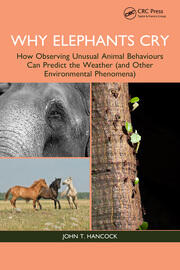
Why Elephants Cry How Observing Unusual Animal Behaviours Can Predict the Weather (and Other Environmental Phenomena)
Preface.
Acknowledgements
Chapter 1: Introduction
Chapter 2: Measuring Ambient Temperature
Chapter 3: Predicting the Weather
Chapter 4: Predicting Earthquakes, Volcanic Eruptions and Tsunami
Chapter 5: Solar and Lunar Activity
Chapter 6: Conclusions, Climate Change and the Future
Appendices
Biography
John T. Hancock is Professor of Cell Signalling at the University of the West of England, Bristol (UWE), UK. In 1984 he was awarded a degree in Biochemistry at the University of Bristol, where he stayed to complete his PhD in 1987. Following post-doctoral positions, he moved to UWE in 1993. John has had a long-standing interest in reduction/oxidation (redox) reactions and the molecules involved, but particularly how these mechanisms control cellular function. He has authored several editions of a textbook, Cell Signalling, where the processes of how cells perceive and respond to their environment is discussed. John also has several editorial positions for international journals, and is Editor-in-Chief of the journal Oxygen. Recently, John’s research has focused on the role of hydrogen gas in biological systems, and he has written several articles on COVID-19, including about the impact of the pandemic on animals and animal welfare.
