




1st Edition
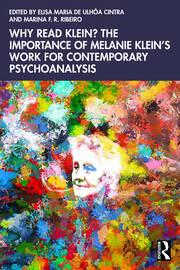
Why Read Klein? The Importance of Melanie Klein's work for Contemporary Psychoanalysis
01. A brief overview of Melanie Klein’s Work: coming to terms with the soul’s wounds
Elisa Maria de Ulhôa Cintra
02. The Kleinian enlightenment project: making the invisible visible
Elisa Maria de Ulhôa Cintra
03. The genius of child analysis and its implications in clinical practice
Elisa Maria de Ulhôa Cintra and Marina F. R. Ribeiro
04. Unconscious phantasy: Contemporary readings
Elisa Maria de Ulhôa Cintra and Marina F. R. Ribeiro
05. The archaic in Klein
Elisa Maria de Ulhôa Cintra and Marina F. R. Ribeiro
06. The paranoid-schizoid and depressive positions: the movement of the mind
Elisa Maria de Ulhôa Cintra and Marina F. R. Ribeiro
07. The feminine position: a theory on femininity and masculinity
Marina F. R. Ribeiro
08. Envy and gratitude: some notes
Elisa Maria de Ulhôa Cintra and Marina F. R. Ribeiro
09. Projective identification: technical developments
Elisa Maria de Ulhôa Cintra and Marina F. R. Ribeiro
10. Reflections from and beyond Melanie Klein
Elisa Maria de Ulhôa Cintra and Marina F. R. Ribeiro
Biography
Elisa Maria de Ulhôa Cintra has a PhD in Clinical Psychology from Pontifícia Universidade Católica of São Paulo (PUC-SP). She is a psychoanalyst and is a professor on the Clinical Psychology Post-Graduate Studies Program at PUC-SP and the Faculty of Human and Health Sciences at PUC-SP. She is also the Coordinator of Laboratory at the Inter-Institutional Laboratory for Studies on Intersubjectivity and Contemporary Psychoanalysis (LIPSIC). In addition, she is the author of books and several articles published in specialized journals.
Marina F. R. Ribeiro, PhD, is a psychoanalyst, full professor and research supervisor and advisor for the Clinical Psychology Postgraduate Program at the University of São Paulo (USP). She is the Coordinator of Laboratory at the Inter-Institutional Laboratory for Studies on Intersubjectivity and Contemporary Psychoanalysis LIPSIC. She is also the author of several books and papers and most recently co-authored Reading Bion’s Transformation (2024) and edited Why Read Ogden? The Importance of Thomas Ogden's Works for Contemporary Psychoanalysis (2025).
'We should see Melanie Klein's thought as an open work. It is a work that reinvents itself with each encounter with contemporary thought, fertilizing it and thus continuing to inspire new perspectives and sow new concepts derived from a deep understanding of her ideas. It is not a matter of accepting or rejecting her in its entirety, but of taking her ideas as a rich model of the functioning of the psychic apparatus. In her work, the process of acquiring knowledge has become a concept with metapsychological status and has been incorporated into most contemporary psychoanalytic theories.'
Elisabeth da Rocha Barros and Elias Mallet da Rocha Barros, training and supervising analysts and docents at the Brazilian Psychoanalytic Society of São Paulo (SBPSP); and fellows of the British Psychoanalytic Society and Institute
