





1st Edition
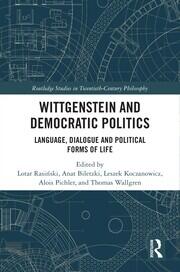
Wittgenstein and Democratic Politics Language, Dialogue and Political Forms of Life
Introduction
1. Wittgenstein and Democratic Politics Lotar Rasiński and Leszek Koczanowicz
Part 1: Grounding the Political
2. The Heart of the Heart: Wittgenstein's Place in Political Theory Thomas Wallgren
3. Using Wittgenstein’s Method to Explain and Understand Democratic Politics Michael Temelini
4. Wittgenstein as a Political Philosopher Richard Raatzsch
5. Wittgenstein’s Lecture on Politics Hans Sluga
Part 2: Conceptual Entanglements
6. Grounding Democracy in Radical Practices of Care: From Sameness to Entanglement Naomi Scheman
7. What Is a “Democratic” Form of Life? Anat Biletzki
8. Community and Temporality: A Wittgensteinian Approach to Political Judgment Désirée Weber
9. Wittgenstein’s “Family Resemblances” and their Political Potential Dimitris Gakis
Part 3: Seeing Connections
10. Wittgenstein, Arendt, and the Problem of Democratic Persuasion Linda M. G. Zerilli
11. Wittgenstein and the Politics of Vision Adam Chmielewski
12. The Proletariat and the Left: Critical Perspectives – Thinking of Political Understanding and Persuasion with Eribon, Arendt and Wittgenstein Anat Matar
13. Language-Based Critique of Deliberation as a “Picture” in the “Album Theory” of Democracy Wojciech Ufel
Conclusion
14. Philosophy and / or Politics: Learning from Engagement with Wittgenstein Thomas Wallgren and Anat Biletzki
Biography
Lotar Rasiński is an Associate Professor of Philosophy at the DSW University of Lower Silesia, Wroclaw, Poland. He is the author of many articles and six books, including the 2012 award-winning monograph, Following Marx and Wittgenstein. Social Criticism without Critical Theory (in Polish), and Marxism and Education. International Perspectives on Theory and Action (ed., Routledge, 2018).
Anat Biletzki is the Albert Schweitzer Professor of Philosophy at Quinnipiac University, USA, and Professor of Philosophy at Tel Aviv University, Israel. She is the author of Philosophy of Human Rights: A Systematic Introduction (Routledge, 2019). Her publications include books and articles on Ludwig Wittgenstein, Thomas Hobbes, analytic philosophy, political thought, digital culture and human rights.
Leszek Koczanowicz is a Professor of Cultural Studies and Political Science at the SWPS University (Poland). Leszek Koczanowicz is the author and editor of many books and articles; his recent books include Anxiety and Lucidity: Reflections on Culture in Times of Unrest (Routledge 2020) and The Emancipatory Power of the Body in Everyday Life: Niches of Liberation (2023).
Alois Pichler is the Head of the Bergen Wittgenstein Archives and teaches Wittgenstein and Philosophy at the University of Bergen. Recent publications include the monograph Style, Method and Philosophy in Wittgenstein (2023) and the article “Glaube und Aberglaube nach Wittgenstein” (2024).
Thomas Wallgren is a Professor of Philosophy, and director of The von Wright and Wittgenstein Archives at the University of Helsinki. He is editor of Challenging Authoritarian Capitalism: The Transformative Power of the World Social Forum (Routledge, 2023) and of The Creation of Wittgenstein: Understanding the Roles of Rush Rhees, Elizabeth Anscombe and Georg Henrik von Wright (Bloomsbury Academic, 2023).
“This important new book gathers together an international line-up of scholars to reflect upon the relevance of one of the twentieth century’s greatest philosophers, Ludwig Wittgenstein, to contemporary concerns about democracy. Every one of the chapters of the book is an original piece, and the book as a whole is a multi-aspect, sustained examination of Wittgenstein’s relevance to contemporary problems of democracy.”
Robert Vinten, Universidade Nova, Lisbon, Portugal
“The work of Ludwig Wittgenstein continues to influence the education of political theorists and the discourse of contemporary political theory. This volume offers an excellent selection of contributions both to our understanding of how to deploy Wittgenstein’s ideas on language, and how Wittgenstein’s philosophy illuminates features of democratic theory and theorizing.”
Christopher C. Robinson, Clarkson University, USA
