





1st Edition
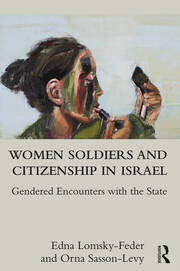
Women Soldiers and Citizenship in Israel Gendered Encounters with the State
- Theorizing Women's Encounters with the State
- Setting the Stage
- Serving the Army as Secretaries: Intersectionality and Multi-Level Contract
- Contrasting Gendered Experiences: Redoing and Undoing Gender
- Contrasting Gendered Experiences: Crossing Boundaries
- Dis/acknowledging Sexual Harassment
- Dis/Acknowledging Military Violence: Women Breaking the Silence
- Gendered Citizenship and Military Service: A Comparative Perspective
Bibliography
Index
Biography
Edna Lomsky-Feder is an Associate Professor at the Department of Sociology and Anthropology and at the School of Education, The Hebrew University of Jerusalem. Her research interests include memory and nationalism, war and military, and personal narratives. Her work has been published in journals such as Sociology, Ethos, Armed Forces & Society, and the British Journal of Sociology.
Orna Sasson-Levy is an Associate Professor in the Department of Sociology and Anthropology and the Program in Gender Studies at Bar Ilan University, Israel. Her research interests include militarism and gender, new social movements, and Israeli ethnicities. She has published in journals such as Gender & Society, The Sociological Quarterly, and the British Journal of Sociology.
Women Soldiers and Citizenship in Israel is carefully researched and designed. Lomsky-Feder and Sasson-Levy write clearly and engagingly. You can distinctly hear their interviewees’ diverse voices throughout. Furthermore, the broad analytical significance of this study – for Sociology, for International Relations, for Gender Studies - is notable.
Dr Cynthia Enloe, Research Professor, Clark University
