




1st Edition
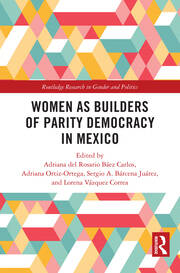
Women as Builders of Parity Democracy in Mexico
Foreword. Introduction. Part 1. The Development of Parity Democracy and Its Progress in the Executive Branch Chapter 1. Mexico’s Gender Revolution: A Blueprint for Parity Democracy in Latin America. Chapter 2. Women Governors Pioneering Gender Transformations in Mexico (1978–2023). Part 2. Advances and Challenges of Parity Democracy in Mexico’s State Legislatures Chapter 3. Beyond Numbers: The Political Strength of Women in Mexican Subnational Legislatures. Chapter 4. “A Time to Build”: Female Legislators Driving Change Across Mexican Legislatures. Chapter 5. Engendering Reelection: Power and Representation in Mexican Legislative Politics. Chapter 6. The Advancement of Equality Agendas in Mexican State Legislatures. Part 3. Challenges in the Gender Equality Agenda Chapter 7. Legislative Pathways for Tackling Violence against Women in Mexico. Chapter 8. Balancing Diversity and Dispersion: Geographic Challenges in the Promotion of Women's Political Participation. Chapter 9. The Integration of Care Systems into Mexico's Political Agenda. Conclusions
Biography
Adriana del Rosario Báez Carlos is Academic and National Researcher Level 1 of the Faculty of Political and Social Sciences of the National Autonomous University of Mexico (UNAM) and Academic Secretary of the Division of Professional Studies. She has served as Director of Gender Studies of the Civil Association Parliamentary Bureau. She has also served as Academic Secretary of the Center for Political Studies of the Faculty of Sciences Political and Social Affairs of UNAM (2014−2020), as District Electoral Advisor in the 2017–2018 and 2020–2021 processes and in the 2022 Mandate Revocation process.
Adriana Ortiz-Ortega is Deputy Director of Gender, Diversity and Inclusion at the National Autonomous Mexican Technological Institute (ITAM). She is a member of the National Researcher System since 2001 in the area of gender and political science. She is also a member of the Advisory Board of the Revista Mexicana de Ciencias Políticas y Sociales, UNAM, the Network of Latin American Women Political Scientists and Mujeres en Plural. She received the Soros award in 2003 and the Promep recognition from the National Ministry of Education in 2006.
Sergio A. Bárcena Juárez is Full-Time Professor and Researcher at Tec de Monterrey, specializing in legislative politics and civic innovation. He has been a member of the National Researchers System (Sistema Nacional de Investigadores) since 2017. In 2018, he founded Buró Parlamentario, a civictech organization focused on enhancing parliamentary transparency and citizen engagement.
Lorena Vázquez Correa is Legislative Researcher at the Belisario Domínguez Institute of the Senate of the Republic in Mexico. She holds a PhD in Law from the Legal Research Institute of National Autonomous University of Mexico (IIJUNAM). Her research focuses on women’s political representation, political violence, and affirmative action.
Women as Builders of Parity Democracy in Mexico provides an in-depth analysis of how Mexico has achieved gender parity in both its upper and lower houses, with women also governing one third of all states. The authors combine interviews with key actors, archival research and a deep understanding of Mexican politics to produce a much-needed analysis of both the enabling factors and the limits faced by women legislators, jurists and activists working in concert to bring gender equality into political life. The 11 chapters analyse the political processes involved, and the favourable judicial and democratic contexts that helped to bring positive results. While formidable obstacles remain in the path of achieving full and diversified equality for women, this excellent collection casts essential light on Mexico’s advances towards it.
Maxine Molyneux, Professor of Sociology, Institute of the Americas, University College London
Women as Builders of Parity Democracy in Mexico could not land at a more fitting moment. In a world where democracy itself is severely threatened, to say nothing of the gains made by organized gender equality movements over the past 50 years, the 2024 election of Claudia Sheinbaum to lead Mexico is, as the book’s editors write, “an unprecedented milestone for democracies across the Americas.” However, the overall tone of this well researched collection is far from celebratory. Through a complex comparative and historical lens, its authors/editors reveal not only Mexico’s and the region’s accomplishments (e.g. 17 female presidents in Latin America since 1974) but also the serious obstacles and challenges that persist—for Sheinbaum specifically and for feminist and all social justice movements more broadly. Anyone interested in gender studies and in Latin American politics and constitutional history will want to read this book.
Rosaline P. Petchesky, Distinguished Professor of Political Science, Hunter College, City University of New York
Women in Mexico have been pioneers at the forefront of developing ‘gender parity’ laws and mechanisms as a means of bringing more women into political positions at the local, regional and national level. They have changed the political discourse and demonstrated that such special measures work in advancing democracy and do make a difference in society. Women as Builders of Parity Democracy explains how this was done and analyses both the successes and the limitations of such measures in a traditionally patriarchal culture, which just elected its first woman president in 2024. This book is a must read for women and men in any country who are interested in advancing the representation of women in politics and thinking seriously about what difference it can make.
Charlotte Bunch, Founder of the Center for Women’s Global Leadership and Distinguished Professor of Women and Gender Studies Emerita, Rutgers University, New Jersey
