





1st Edition
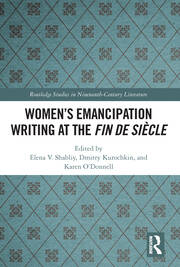
Women's Emancipation Writing at the Fin de Siecle
Introduction
The New, but New with G*d
Elena V. Shabliy
Chapter 1
Women’s Labor Activism in the Progressive Era and Marie Van Vorst’s Amanda of the Mill as a Social Propaganda Tool
Emine Gecgil
Chapter 2
"I have been wronged, and I long to right myself at once": Revenge, Deceit and Female Power in Louisa May Alcott’s Sensational Short Fiction
Evangelia Kindinger
Chapter 3
Who’s Afraid of Women Photographers? Redefining Gender, Gaze, and Photography in Amy Levy’s The Romance of a Shop
Mavis Chia-Chieh Tseng
Chapter 4
Rediscovering London in Ella Hepworth Dixon’s The Story of a Modern Woman
Sun Jai Kim
Chapter 5
The First "New Woman" in Modern Hebrew Literature: Finalia Adelberg in Love of The Righteous, or, The Persecuted Families by Sarah Feiga Meinkin
Michal Fram Cohen
Chapter 6
Gendering the Empire: The Discourse on the New Woman and Emergence of Ottoman Feminism, 1860-1918
Burcin Cakir
Chapter 7
Gertrudis Gómez de Avellaneda: A Feminist Life and its Discourse
Laureano Corces
Chapter 8
Harriet Beecher Stowe and Two Fin de Siècle Women Writers
Afrin Zeenat
Chapter 9
Women’s Roles in Mass Literacy, Production, and Sensation in George Gissing’s New Grub Street
Robin M. Mako Citarella
Conclusion
Biography
Elena V. Shabliy is a Visiting Scholar at Columbia University and a Postdoctoral Fellow at Harvard University.
Dmitry Kurochkin is a Research Associate at Harvard University.
Karen O’Donnell is the CODEC Research Fellow at Durham University.
