




1st Edition
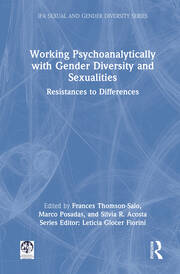
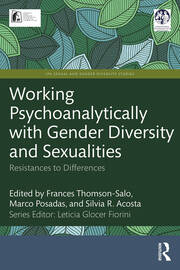
Working Psychoanalytically with Gender Diversity and Sexualities Resistances to Differences
List of Contributors
Series editor preface
Introduction
Marco Posadas, Silvia Acosta, and Frances Thomson-Salo
Part 1. Theoretical and technical changes within
psychanalysis: Gender and sexualities
Introduction
Angela Vila-Real
1. The Oedipus complex: An expanded approach on sexual and gender polyphonies
Leticia Glocer Fiorini
2. Psychosexuality and the problem of (mis)representation: A mentalizing perspective
Liz Allison
3. Encountering otherness: On the ability (and inability) for psychic movement within sexual states of mind
Anat Schumann
4. Shapes of gender identity: Three stories with an impact
Domenico di Ceglie
Part 2. Psychoanalytic ethics and depathologising gender diversities and sexualities: Intolerance as an unconscious response to violence in analytic field
Introduction
Marco Posadas
5. The many colours of the rainbow: Depathologising sexual diversity
Sergio Lewkowicz
6. Towards a psychoanalytic ethics-based practice with transgender individuals
Alessandra Lemma
7. A history of reception: Falling apart as the ground for learning
Oren Gozlan
Part 3. In search of complexity
Introduction: Beyond binary logic: In search of complexity
Nicolas Evzonas
8. Gender fixed and fluid: Gender and suffering, gender, and transformation
Adrienne Harris
9. Gender crossing as caesura versus gender crossing as cut
Dana Amir
a) Eva Reichelt Discussion of Chapter 9
b) Elda Abrevaya Discussion of Chapter 9
10. On Trying to Pass off Transphobia as Psychoanalysis and Cruelty as “Clinical Logic”: Gender Dysphoria
Avgi Saketopoulou
Biography
Frances Thomson-Salo, Ph.D., is an adult and child psychoanalyst, European co-chair of the IPA Sexual and Gender Diversity Studies committee, and member of the International Journal of Psychoanalysis Board. She was an Associate Professor, Department of Psychiatry, University of Melbourne, specialising in infant mental health.
Marco Posadas, RSW, MSW, PhD is a psychoanalyst based in Toronto, and inaugural chair of the IPA Sexual and Gender Diversity Studies Committee. He received the 2018 Sue Fairbanks Excellence in Psychoanalytic Knowledge Distinguished Lecturer award, the 2022 Distinguished Social Worker for Toronto award, and is the 2024-2025 Antoinette Calabria visiting scholar for the Psychoanalytic Center of the Carolinas.
Silvia R. Acosta, PsyD, PhD is an Argentinian psychoanalyst, member of the SPP and the APC, a member of the IPA Sexual and Gender Diversity Studies Committee, and a co-founder of the FEPAL Working Party on drive constellations and subjectivation processes. She has published psychoanalytic articles and teaches on sexual and gender diversity in Europe and Latin America.
“At a time when free thinking and a democratically legitimate, diverse culture are increasingly under threat worldwide, this book provides a scientifically sound wake-up call to preserve open thinking not only in our culture and society, but also within our psychoanalytic community. With their consistent plea for an opening and fluidity of psychoanalytic theory and practice in the realm of sexuality and gender, the authors repeatedly touch on the original field of psychoanalysis. At the same time, their multi-layered message is: we need resistance to arbitrariness in our psychoanalytic concepts, but also resistance to normative restriction in the diversity of innovative theories on socially new, often still incomprehended forms of sexuality and gender. This is an excellent book that cannot be pigeonholed into any psychoanalytic cliché, but opens up creative spaces for thought and life.” - Dr. med. Heribert Blass, IPA President elect
“The paradox at the heart of psychoanalysis--without resistance, there can be no cure; yet when resistance calcifies, the analytic process stalls--shapes every treatment, implicating both analyst and analysand. With candor and precision, the ten essays in this volume—authored by a distinguished group of international clinicians—trace the evolving contours of resistance as it intersects with gender, embodiment, and the enduring question of sexual difference. It is, unmistakably, essential reading for the contemporary psychoanalyst.” - Patricia Gherovici, Ph.D. psychoanalyst, Sigourney Award winner, and author of Transgender Psychoanalysis.
