





1st Edition
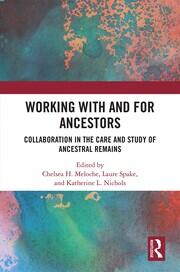
Working with and for Ancestors Collaboration in the Care and Study of Ancestral Remains
Part 1 Building Relationships: Proceed with Respect and Patience
1 Bearing Witness: What Can Archaeology Contribute in an Indian Residential School Context?
Eric Simons, Andrew Martindale, and Alison Wylie
2 Pathway to Decolonizing Collections of Ainu Ancestral Remains: Recent Developments in Repatriation Within Japan
Mayumi Okada
3 The Brandon Indian Residential School Cemetery Project: Working Towards Reconciliation Using Forensic Anthropology and Archaeology
Katherine L. Nichols
4 Washington’s Non-Forensic Human Skeletal Remains Law and the State Physical Anthropologist: A Collaborative Process and Model for Other States
Guy L. Tasa, Juliette Vogel, and Lance K. Wollwage
5 Bii-Azhe Ḡiiwé Iná Daanig (Let’s Bring Them Home): Lessons in Humility, Relationships, and Changing Perspectives
Kayleigh Speirs and Tasha Hodgson
Part 2 Caring for the Ancestors: Developments in Museum Collaborations
6 Why We Repatriate: On the Long Arc Toward Justice at the Denver Museum of Nature & Science
Chip Colwell and Stephen E. Nash
7 the Importance of Kaitiakitanga (Guardianship and Care) and Rangahau (Research) for the Karanga Aotearoa Repatriation Programme
Amber Aranui and Te Arikirangi Mamaku
8 Toward a Twenty-First-Century Model for the Collaborative Care and Curation of Human Remains
Emily Hayflick and Helen a. Robbins
9 The Southern African Human Remains Management Project: Making (P)Reparations in Year One
Wendy Black and Keely Mccavitt
10 Caring for the Ancestors at the Royal BC Museum
Lucy Bell, Sdaahl K’awaas and Genevieve Hill
Part 3 Learning From the Ancestors: Collaborative Research Projects
11 The Journey Home: Sto:Lō Values and Collaboration in Repatriation
David M. Schaepe and Susan Rowley
12 the Joy of the Souls: the Return of the Huron-Wendat Ancestors
Crystal L. Forrest, Ronald F. Williamson, Susan Pfeiffer, and Louis Lesage
13 Building Relationships to Shift Accountability: Doing Paleogenomic Research with Indigenous Nations and Ancestors
Alyssa C. Bader, Aimee E. Carbaugh, Jessica Bardill, Ripan S. Malhi, Barbara Petzelt, and Joycelynn Mitchell
14 Learning from Ancestors Caring for Ancestors: The Antiquity of Reburial On Bkejwanong
Dean Jacobs, David White, Neal Ferris, and Michael W. Spence
15 New Insights from Old Dog Bones: Dogs as Proxies for Understanding Ancient Human Diets
Bonnie Glencross, Louis Lesage, Tracy Prowse, Taylor Smith, and Gary Warrick
Part 4 Developing Conversations: Doing Better Together
16 The Digital Lives of Ancestors: Ethical and Intellectual Property Considerations Surrounding the 3-D Recording of Human Remains
Laure Spake, George Nicholas, and Hugo F.V. Cardoso
17 What Next? Changing Ethical Protocols for Human Remains in Museums
Lia Tarle, George Nicholas, and Hugo F.V. Cardoso
18 Provenancing Australian Aboriginal Ancestors: The Importance of Incorporating Traditional Knowledge
Anna Weisse
19 Ancient Human DNA: Surveying the Evolving Ethical, Social, and Political Landscape
Alexa R. Walker
Part 5 Moving Forward: There’s Still Work To Do
20 Identity in Applied Repatriation Research and Practice
Cressida Fforde, C. T Imothy Mckeown, Honor Keeler, Lyndon Ormond-Parker, Paul Tapsell, Paul Turnbull, Steve Hemming, Daryle Rigney, Michael Pickering, Amber Aranui, Wes Morris, and Gareth Knapman
21 Decolonizing Bioarchaeology? Moving Beyond Collaborative Practice
Kisha Supernant
Biography
Chelsea H. Meloche is a PhD candidate in the Department of Archaeology, Simon Fraser University, where she is investigating the effects of repatriation. Her research interests also include critical cultural heritage studies and collaborative and decolonizing research strategies in archaeology and biological anthropology.
Laure Spake is a Post-doctoral Research Fellow at the University of Otago, where she researches child growth and development, demography, and human variation in past and present populations. She has also written on ethical issues relating to collections and technology in biological anthropology.
Katherine L. Nichols is a PhD student working between the Departments of Indigenous Studies and Archaeology at Simon Fraser University, and is affiliated with the Centre for Forensic Research. Her research focusses on applying forensic and archaeological methods to Indian residential schools in Canada.
