





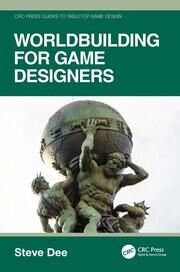
Foreword
Acknowledgements
Introduction
Part One: General Principles
1. Worlds Must Be Built to Purpose
2. Setting Exists To Communicate Mechanics
3. Worlds and Games Are Built On Narratives
4. World Building is Character Building
5. Astrology not Astronomy
6. Realism and Believability
7. Keep Asking Questions
8. Question Everything
9. Reality is Your Muse
10. Keeping Asking People
11. Rigidly Defined Areas of Doubt and Uncertainty
12. Embodiment and Anthropology
Part Two: Breaking Ground
13. Extrinsic and Intrinsic Worldbuilding
14. Start Small and End Small
15. Go Big and Go Home
16. The Richard Scarry Interrogative
17. Gods and Monsters
18. The Map is not the Territory
19. Genesis and the Bible
20. Top Down…
21. …and Bottom Up
22. The Spongebob Technique
23. Good vs Evil and Other Popular Brands
24. Psychographics and Psychodrama
25. Plot Armour and Railroading
Part Three: Developing Your World
26. Never Say Never Again
27. Pipe and How To Lay It
28. The Slice of Life
29. Signs and Signifiers
30. Synecdoche and Statistics
31. A Game Is A Map
32. Teaching and Example
33. The Jimmy Olsen Blues
34. The Ray Arnold Principle
35. Filling the Fractal
36. Borrowing, Stealing and Appropriating
37. Lawyers, Puns and Money
Afterword
Index
Biography
Steve Dee has worked in games for thirty years as a designer, writer, editor, journalist, consultant, organiser and educator. He has won five ENNIE Awards for RPG design, most recently for CHEW: The Roleplaying Game, and he has won Best Non‑Digital Game at the 2024 Freeplay Awards for The Score. His card game There’s Been A Murder has sold over 100,000 copies and been translated into three languages. He is the president of Tin Star Games.
“Steve Dee’s book is the best work on worldbuilding since the Hadean Eon.” – Dan Abnett, New York Times bestselling author and writer of wrongs.
“I can count on Steve always to deliver on the creativity. He has a knack for digging in deep and coming up with something marvelous! When it comes to worldbuilding, he knows his subject and would-be game designers can learn a lot from him.” – Robert J Schwalb, Game Designer (Shadow of the Demon Lord, Dungeons & Dragons, Warhammer Fantasy Roleplay)
