




1st Edition
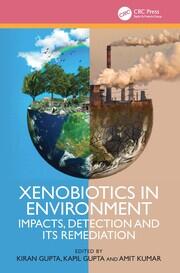
Xenobiotics in Environment Impacts, Detection and its Remediation
Chapter 1. Xenobiotics: A Threat to the Health of Living Organisms
Ruchita Shrivastava, Aparna Satapathy, Vaishnavi Srivastava, Pranav Shukla, and Richa Saxena
Chapter 2. Persistent Organic Pollutants (POPs), A Threat to Arctic Environment and Their Impact on Human Health
Laxmi Kant Bhardwaj, Rashmi Mittal, Prangya Rath, Urvashi Gupta, Diksha Bhardwaj, Yubraj Dahal, and Amit Kumar
Chapter 3. Relationship between Persistent Organic Pollutants (POPs) and Antarctic Environment: Contemporary and Potential Implications for Human Health
Shalini Thakur, Laxmi Kant Bhardwaj, Prangya Rath, Yogesh Kumar Sharma, and Amit Kumar
Chapter 4. Devastating Impact of Persistent Organic Pollutants on Arctic Environment and Human Health
Sarvesh Kumar, Vishnu kumar, Vaishali Vir, Sanjay Dwivedi, Rajesh Kumar Tewari, and Vivek Pandey
Chapter 5. Anthropogenic Source of Xenobiotics and its Bioaugmentation
Prarthana Modanwal, Kapil Gupta, Amit Kumar, and Kiran Gupta
Chapter 6. Xenobiotics: Metabolism and Risk Assessment
Praveen Maddheshiya, Priyanka Bharti, Rupali Kasaudhan, and Kapil Gupta
Chapter 7. Effects of Xenobiotics on Chemical Carcinogenesis and Toxicology
Priyanka Bharti, Unnati Upadhyay, Taslima Nasrin, Babli Kushwaha, Shilpi Pandey, Praveen Maddheshiya, Shreenkhla Kumari, Pawan Kumar Doharey, and Sarad Kumar Mishra
Chapter 8. Defense Mechanism of Tolerant Plants to Combat Xenobiotics
Seema Manwani, Pooja Devi, Garima Awasthi, Anjali Awasthi, Anuj Sharma, and Kumud Kant Awasthi
Chapter 9. Remediation and Detoxification of Xenobiotics Through Plants
Ragini Sikarwar, Aparna Satapathy, Nishtha Srivastava, Bhramar Pal Singh, Vaishnavi Srivastava, and Richa Saxena
Chapter 10. Remediation and Detoxification of Emerging Xenobiotic through Plants
Vartika Gupta, Namita Gupta, and S.K. Dwivedi
Chapter 11. Remediation of Xenobiotics: Advances and Current Approaches
Govind Gupta, Priya Saini, and Naveen Kumar Singh
Chapter 12. Xenobiotic Pollution Degradation by Transgenic Methods: A Sustainable Solution for the Environment
Tuhinendu Dey, Debarati Roy, and Suchismita Das
Chapter 13. Microbe Assisted Degradation of Xenobiotics
Pradeep Kumar Singh, Vidyanand Tiwari, Pankaj Singh, Manikant Tripathi, Neelam Pathak, Farrukh Jamal, and Rajveer Singh Chauhan
Chapter 14. Microbial Assisted Bio-Remediation Strategies for Mitigating Heavy Metal Contaminants
Megha B M, Snigdha Ghosh, Gopalakrishnan Menon, and Sumitra Datta
Chapter 15. Xenobiotics in the Environment: A Futuristic Approach
Raushan Kumar, Rajveer Singh Chauhan, and Anjali Singh
Chapter 16. Xenobiotic Contamination in Soil Environment and Their Current Remediation Strategies
Pinki Koiri, Rollen Yanthan, Pijush Singha, and Suchismita Das
Chapter 17. Current Approaches for Remediation of Xenobiotics
Hari Prakash Yadav and Avinash Kumar Chaurasia
Chapter 18. Anthropogenic Sources of Xenobiotics: Pathways, Environmental Impacts, and Bioaugmentation Strategies
Vineeta Rawat and Sunita Rawat
Biography
Kiran Gupta is an Assistant Professor at Siddharth University, Kapilvastu in Botany subject. She has been awarded with two Post Doctorate Fellowships at University of Lucknow, Lucknow. She was awarded with UGC-Post Doctorate Fellowship for women candidate scheme of 5-year duration (2016-2021). Another Post doctorate Fellowship was CSIR-Research Associate of 3-year duration (2009-2012). She served Department of Botany, University of Lucknow, Lucknow as Guest Faculty from 2012-2016. Her specialization is in Cyto-genetics, heavy metal Toxicity, stress physiology and Phytoremediation in response to xenobiotics. She has got Ph.D degree in Botany subject from Department of Botany, University of Lucknow, Lucknow (2007). She has been engaged in various aspects of toxic impact of industrial discharges, metal/metalloid, stress physiology along with phytoremediation strategy of xenobiotics. Moreover, she has worked out on cyto-genetics, chromosomal normal as well as abnormal behavior, function of spindle fibre, cell division activity and micronuclei endpoint exposed to xenobiotics. She has worked on mitigation of arsenic in crop plants through utilizing ornamental fern Pteris vittata. She utilized aquatic macrophytes like Eichhornia crassipes and Bacopa monnieri for phytoremediation of xenobiotics like tannery effluent, chromium and lead. She has published more than 50 research papers/book chapters/conference proceedings. She has published 2 books from International publisher Lambart, Germany. She is a life member of several National/International societies. She has also served as a reviewer for various national and international journals. She has been conferred several Awards for her contribution, including Uddeepan Award-2020 and 2021 along with best research paper award-2019.
Kapil Gupta is an Assistant Professor at Siddharth University, Kapilvastu in Biotechnology. His research focuses on abiotic stress signaling as well as metabolites from medicinal plants, especially the biosynthesis pathways of delphinidin, taraxerol in medicinal plant 'Aparajita' and engineering terpenoid pathway in Ocimum sp. by targeting YABBY TFs at CSIR-CIMAP, Lucknow. He has obtained postgraduate degree in Biotechnology from Deen Dayal Upadhyaya Gorakhpur University. Later he obtained Ph.D. degree from CSIR-CSMCRI Bhavnagar, Gujarat on the topic Functional analysis of DREB Transcription Factor from a halophyte Salicornia brachiata for abiotic stress tolerance in 2013. He has postdoctoral research experience of working at Agriculture Research Organization, Israel on Transcriptome analysis of peanut seed and shell development. Later he worked as postdoctoral fellow at Central University of Rajasthan, India on Transcription Factors associated with abiotic stress and secondary metabolism in tomato. His research work has been published in International and National Journals like BMC Plant Biology, Plant Science, Frontiers in Plant Science, Journal of Experimental Botany, Food Research International, Plant Cell Reports, Planta etc. and he was awarded Young Researcher Award by INSc.
Amit Kumar is currently working at CSIR-National Botanical Research Institute. He has also worked as a National Post-Doctoral Fellow in Department of Botany, University of Lucknow, Lucknow, India. He received his Ph.D. in Environmental Science (2015) from Babasaheb Bhimrao Ambedkar University, Lucknow, Uttar Pradesh, India. He is engaged in various aspects of metal/metalloid phytoremediation, biochemical and molecular approaches with a special emphasis on reducing heavy metal accumulation. He is working on mitigation of arsenic in crop plants and green leafy vegetables with enhancing grain yield through biogenic nanoparticles and elemental based formulation for arsenic affected areas. He has published 36 research papers with total impact factor 184, H-index 24 and total citation 2450. He has also published many national and international book chapters and magazine articles. He has presented a paper in international conference at Gdańsk, Poland in 2015. He is a life member of several societies as well as non-governmental organizations. He has also served as a reviewer for various national and international journals. He has been conferred several Awards for his contribution, including Protsahan Award-2021; Awsar Award-2020 and Young Scientist Award-2018.
