





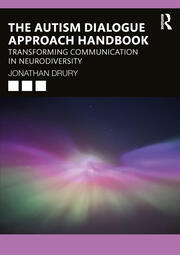
1st Edition
The Autism Dialogue Approach Handbook Transforming Communication in Neurodiversity
Foreword
Preface
Acknowledgements
PART 1: What Are We Dealing With Here?
1. What Brings Us Here?
Growing up
The seeds of Autism Dialogue
First experiments with dialogue
A handbook
How to read this book
2. Autism as a Way of Being
Discovery journey
Autistic culture
3. Dialogue in Historical Context
Traditional communities and societies
Dialogue and indigenous societies
East and west dialogues
Dialogue in practice
4. Bringing Together Autism and Dialogue
The importance of mindful awareness
Experiences in early dialogue sessions
PART 2: Communities of Meaning-Making
5. Introduction to Dialogue in autism contexts
The key principles and aims of Autism Dialogue
Explicit aims
The four practices
Using the four practices in a group
Further considerations around sensitive conversation
The benefits of an ADA practice
6. Autism Theories and Common Themes
What is autism?
Autism as a way of being
Monotropism
Stress adaptation
Double empathy (Milton, 2012)
Autistic communication styles
Autistic peer to peer information transfer is highly effective
Sensory sensitivity: The intense world
Masking
Trauma - an introduction
Other problems that autistic individuals may face
The need for dialogues in autism
7. Autism and Dialogue Through the Lens of Social Sciences
Nature of Self
Dialogue as a system
Letting be, thinking, participatory sense-making and generative dialogue
Bohm's theory of Wholeness and the Implicate Order
Systemic trauma
Lockdown
How can Dialogue address communication breakdown?
8. Neurodiversity
Problems with neurodiversity
Does the neurodiversity paradigm compare to autistic gestalt processing?
So do we need neurodiversity and if so, why?
9. Autism Dialogue and Mindfulness
Introduction to mindfulness
Silence
Mindful talking and awareness in dialogue groups
Suggested questions for mindfulness in dialogue
Some thoughts on self-acceptance
Interoception
Effortless effort
Mantras, moving and other creative devices
Some evidence
10. Guide to Hosting an Autism Dialogue
Introduction
How to prepare for a Dialogue
Who’s invited, who isn’t?
A conducive environment for Dialogue
Let’s begin!
Contracting
Additional guidelines
Ideas for checking in
How to address common themes
When boundaries aren’t in place
Closure
Recording feedback
11. Autism Dialogue Facilitation Skills
Participatory considerations
Digital age
Qualities and skills of a group facilitator
Facilitating dialogue: responsibility and ethics
Ethical considerations
Evaluating dialogue: the art of not knowing and navigating uncertainty
Facilitating the generative potential of dialogue
The Autism Dialogue Approach: training for facilitators
Qualities of an ADA-trained practitioner
Autistic only group?
Working with an organisation
Professional Dialogue
PART 3: WIDER CONTEXTS
12. Intersectionality and Dialogue
Intergroup Dialogue
The Cycles of Socialisation and Liberation
My experience in Intergroup Dialogue
Exercise: questions to ponder
13. Insight Dialogue and Other Models
Pedagogy of the Oppressed
Dialogism and ethical and spiritual interaction; Buber and Bakhtin
Circles of Trust
The Socratic Seminar
World Café
14. Autism Dialogue in Therapy and Coaching
Autism and existence
Talking
An enactive approach to the helping relationship
Autistic trauma
Masking and the therapeutic process: the role of interaction
Dialogic supervision
The importance of safe, neurodivergent-affirming therapeutic spaces
Relational humility and the paradigm shift in therapy
Training and implementation: ADA as a transformative practice
Conclusion: toward a more inclusive and relationally engaged therapeutic practice
15. Spirituality in Autism Dialogue
Non-Violent Communication
Spiritual community
Spiritual practice and the inner world of autistic people
16. Resistance to Change
An autistic leadership culture
APPENDICES
Appendix 1
Case Example: Autism Dialogue in Derby City & Derbyshire (England, UK)
Appendix 2
Case Example: Community Online Series 2022
Appendix 3
Case Example: Post-Dialogue Group Community – “Autism Dialogue Friends”
Appendix 4
Case Example: Autism Dialogue Coaching
Appendix 5
Case Example: An Encounter
Appendix 6
A Note on Research and Evaluation
Appendix 7
An Open Letter About Communication
Biography
Jonathan Drury has been an expert in autism, neurodiversity and environmental trauma for over ten years, working with individuals, teams and organisations across the UK and internationally. He has designed experiential programmes that explore the healing power of dialogue from a unique and universal perspective, and a range of transformative tools and approaches for wider perspectives and deeper understanding in autism wellbeing and leadership. His work has empowered countless individuals to navigate their lives with increased confidence and clarity. A regular speaker and trainer, Jonathan draws on ancient health philosophies, somatic awareness, the arts, spiritual disciplines and many established dialogue modalities to offer a fresh lens on neurodiversity and leadership. The Autism Dialogue Approach Handbook is his first book.
'The Autism Dialogue provides an insightful perspective… [and] aims to replace a negative deficit-based view with teaching people about the benefits of autistic ways of perceiving the world.'
Temple Grandin, author of Visual Thinking and Thinking in Pictures, USA
'This text succinctly outlines the value of the Autism Dialogue Approach and the ways it can be used to enable deeper communication, respect and connection.'
Professor Elizabeth Milne, Professor of Cognitive Neuroscience, The University of Sheffield, UK
'a vital contribution to researchers and practitioners across many fields.'
Lori Hogenkamp, Center for Adaptive Stress, USA
'With this impressive handbook, Jonathan not only emancipates "Autism" from the shackles of conventional labelling, he also provides us all – whatever our neurotype – with deeply considered ideas to help us fully embrace our own uniqueness and that of others.'
Vincent Traynor, Associate Professor of Change Leadership, Sheffield Business School
'With this book, Jonathan offers us the gift of a veritable view from within the world of autistic experience, a perspective that takes seriously the notion that practical knowledge about human experience is the royal road – and the active principle – for understanding how our minds are not isolated but work together to bring forth meaningful worlds.'
Amy Cohen Varela, Clinical Psychologist, Chair of Mind & Life Europe, Switzerland
'The principles of Autism Dialogue are eloquently explained in this innovative book. It provides the reader with insights into a strengths-based approach that can empower. The author invites us to consider the richness of lived experiences via self and mutual understanding. This approach has great potential to reduce harmful societal misunderstandings of autism. The Autism Dialogue Approach needs to be embraced.'
Megan Freeth, Professor of Neurodevelopmental Psychology. University of Sheffield, UK
