




1st Edition
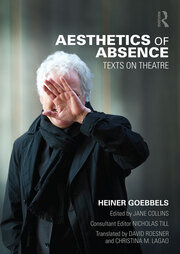
Aesthetics of Absence Texts on Theatre
Contents
List of Illustrations
When a Tree is Already Being Mentioned, You Don’t Also Have to Show It
A Preface
Aesthetics of Absence
How it all began
PART I: Texts on Work(s)
Description of a Picture, Table-Parties and Comparative Degrees
About the opera Landscape with Distant Relatives
‘Some Things You Only Remember, Because They Don’t Have Anything To Do With Anything’
Questions on constructing Eraritjaritjaka
Real Time In Oberplan
A Theatre of Deceleration
Peculiar Voices
On working on I Went to the House But Did Not Enter
The Space as Invitation
The spectator as the object of art
PART II: Texts on Artists
‘But I wanted this to be a narrative’
Jean-Luc Godard as a composer
What We Don’t See, Attracts Us
Four theses on Call Cutta by Rimini Protokoll
The Mystery Of Signs
For Robert Wilson
Trust No Eye
For Erich Wonder
‘To Comprehensively Build Up A Society With Modest Prosperity’
The Ensemble Modern as an example
PART III: Texts on Education
Research or Craftsmanship?
Nine theses on the future of an education for the performing arts
If I Want An Actor To Cry, I Give Him An Onion
On working with actors
A Giant Wooden Pistol
Theory and Practice in Gießen
Organising Hearing and Seeing
The Practical Study of Theatre
Compromise Is a Bad Director
Theatre as museum or laboratory
Appendix
Biography
Biography
Heiner Goebbels is a professor at the Institut für Angewandte Theaterwissenschaft of the Justus-Liebig-University Gießen, President of the Hessische Theaterakademie, and Artistic Director of the Ruhrtriennale – International Festival of the Arts.
"This book will have a wide appeal for scenographers, designers, theatre makers, students and academics who are interested in the interplay of theatre objects directly from the perspective of an exemplary practitioner of the form. [...] a welcome and stimulating perspective."
- Theatre, Dance and Performance Training
"A significant contribution to shifting the margins and the centre of the discourse on practice."
- Ed McKeown, Critical Perspectives on Contemporary Art and Culture
