




1st Edition
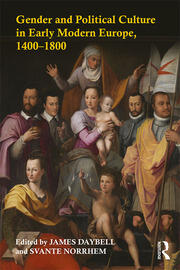
Gender and Political Culture in Early Modern Europe, 1400-1800
Introductions
1. James Daybell and Svante Norrhem, ‘Introduction: Gender and Political Culture in Early Modern Europe’
2. James Daybell, ‘Gender, Politics and Archives in Early Modern England’
Diplomacy, Gifts and the Politics of Exchange
3. Susan Broomhall and Jacqueline Van Gent, ‘Material Culture as Power: Gendered Strategies of Power in an Early Modern Dynasty’
4. Svante Norrhem and Peter Lindström, ‘Diplomats and Kin Networks: Diplomatic Strategy and Gender 1648-1740’
Socio-Economic Structures, Gender and Politics
5. Randi Bjørshol Wærdahl, ‘Female Agency in Favourable Political Circumstances Lady Ingerd Ottesdotter and the Benefits of Holding Crown Fiefs in Norway in the 1520s’
6. Barbara J. Harris, ‘Female Networks and Horizontal Families’
7. Elise M. Dermineur, ‘Widows’ Political Strategies in Traditional Communities: Negotiating Marital Status and Authority in Eighteenth Century France’
Women and Gendered Politics at Court
8. Victoria Smith, ‘"For ye, young men, show a womanish soul, yon maiden a man’s": Perspectives on Female Monarchy in Elizabeth’s First Decade’
9. Sarah Bercusson, ‘Strategies for Survival: Women at the Court of the Medici (1565-1587)’
Voting and Political Representation
10. Elaine Chalus, ‘"To serve my friends": Women and Political Patronage in Eighteenth Century England’
11. Hilde Sandvik, Åsa Karlsson Sjögren & Peter Lindström, ‘Gender, Politics and Voting in Early Modern Scandinavia’
Conclusion: Global Perspectives
12. Merry Wiesner-Hanks, ‘Gender and Cultural Power in Global Perspective’
Biography
James Daybell is Professor of Early Modern British History at Plymouth University. His previous publications include The Material Letter in Early Modern England: manuscript letters and the culture and practices of letter-writing, 1512–1635 (2012) and (as editor) Women and Politics in Early Modern England, 1450–1700 (2004).
Svante Norrhem is Associate Professor of History at Lund University. His previous publications include Flattering alliances: Scandinavia, diplomacy and the Austrian–French balance of power, 1648–1740 (with Peter Lindström).
"Daybell and Norrhem have provided a set of studies that are at once wide-ranging, and tightly connected by the issues of women’s often-overlooked roles in the exercise of power. This will be a valuable volume for undergraduates, graduates, and scholars alike, addressing issues of archives, material culture, the varieties of "soft" power, and global comparisons, which in total builds a compelling case for the centrality of gender and women’s roles in ruling."
- James Coons, Miami University, USA"Established researchers and student–scholars alike, and particularly scholars of women’s history, will relish this book for its wealth of information, clarity of writing, and new archival findings."
- Goran Stanivukovic, Renaissance and Reformation
