





1st Edition
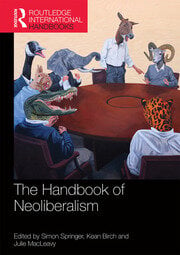
The Handbook of Neoliberalism
Biography
Simon Springer is an Associate Professor in the Department of Geography at University of Victoria, Canada.
Kean Birch is an Associate Professor in the Department of Social Science at York University, Canada.
Julie MacLeavy is a Senior Lecturer in Human Geography at the University of Bristol, UK.
'This extraordinary collection offers a comprehensive review of neoliberalism. It answers all questions you may have about neoliberalization including those you might be afraid to pose. A must read for all those who believe that a different world must be possible.'
Erik Swyngedouw, MAE, Professor of Geography, School of Education, Environment and Development, Manchester University, UK
'Providing a comprehensive introduction to one of the most contentious terms in contemporary social science, this multi-disciplinary handbook draws together established scholars and new contributors. Collectively these authors offer an extraordinarily wide range of debates and perspectives, making this a landmark contribution to the field.'
Wendy Larner, Provost and Professor of Human Geography, Victoria University of Wellington, New Zealand
'This is the most wide-ranging and multi-perspectival overview of neoliberalism available. The book is a true treasure trove where graduate students can find countless ideas for designing original research projects.'
Henk Overbeek, Professor Emeritus of International Relations, Vrije Universiteit Amsterdam, Netherlands
"‘Neoliberalism is a slippery concept, meaning different things to different people’ (p. 1). Springer, Birch and MacLeavy’s excellently edited volume starts its mission with this nailing definition. Neoliberalism has become one of the concepts that one cannot avoid mentioning in analysing a recent development in social sciences. It is safe to argue that neoliberalism is now a term that is overly used even in partly overlapping and partly contradictory ways (Ferguson 2010: 166). There is not any easy way of defining what neoliberalism is. Is it a state form, or a policy, or a version of governmentality, or an ideology? Or simply, is it an epistemology? Perhaps, because of this nuisance, no scholar has attempted t
