





1st Edition
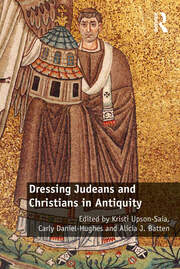
Dressing Judeans and Christians in Antiquity
Part 1 Dress and The Social Body 1. What to Wear: Women’s Adornment and Judean Identity in the Third Century Mishnah. 2. Coming Apart at the Seams: Cross-dressing, Masculinity, and the Social Body in Late Antiquity. Part 2 Dress and Relationality 3. "The Holy Habit and the Teachings of the Elders": Clothing and Social Memory in Late Antique Monasticism. 4. Unraveling the Pallium Dispute between Gregory the Great and John of Ravenna. Part 3 Dress and Character Types 5. The Unibrow That Never Was: Paul’s Appearance in the Acts of Paul and Thecla. 6. Adorning the Protagonist: The Use of Dress in the Book of Judith. Part 4 Dress and Status Change 7. A Robe like Lightning: Clothing Changes and Identification in Joseph and Aseneth.
8. Hairiness and Holiness in the Early Christian Desert. Part 5 Dress, Image, and Discourse 9. Sizing up the Philosopher’s Cloak: Christian Verbal and Visual Representations of the Tribōn. 10. Imagining Judean Priestly Dress: The Berne Josephus and Judaea Capta Coinage. Part 6 Dress and Material Realities 11. Putting on the Perfect Man: Clothing and Soteriology in the Gospel of Philip. 12. The Paradoxical Pearl: Signifying the Pearl East and West.
Biography
Kristi Upson-Saia is Associate Professor of Religious Studies at Occidental College in Los Angeles, USA.
Carly Daniel-Hughes is Associate Professor of Religion at Concordia University, Canada.
Alicia J. Batten is Associate Professor of Religious Studies and Theology at Conrad Grebel University College at the University of Waterloo, Canada.
"the book is an impressive one, demonstrating thoughtful approaches, both grounded in close textual analysis and successfully drawing upon a wide range of social theory that yields new perspectives on the question of what Judean and early Christian dress is for."
- Ellen Swift, University of Kent
