




1st Edition
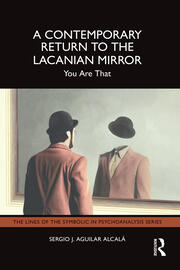
A Contemporary Return to the Lacanian Mirror You Are That
Series foreword by Ian Parker
Foreword by Alfie Bown
Acknowledgements
Chapter 1. Introduction: You are that Dolphin
Chapter 2. Freudian Identification: Two Paths
Chapter 3. Lacanian Identification: An Imago for the Subject
Chapter 4. Animals and the Lacanimal
Chapter 5. The Fragmented Self and its Selfie
Chapter 6. Psychologist Barbie and Worker Ken: The Traps of the Self
Chapter 7. Concluding Remarks: You are that Manticore
Biography
Sergio J. Aguilar Alcalá practices psychoanalysis in Mexico and has published several works at the intersections of psychoanalysis, communication theory, and film studies.
“The message of psychoanalysis, masterfully voiced by Sergio Aguilar, goes against the grain of our psychologized, almost zoological “self(ie) understanding”, the latter perfectly attuned to neoliberal digitalized capitalism. Look into Aguilar’s Lacanian mirror, and see another subject: alienated in its own image and body, always differing from what it says/is said to be. Behold that subject, “necessarily presuppos[ing] the other”: this perspective is indispensable for those who still believe in collective emancipation.”
– Jan De Vos, psychoanalytic theorist and author of amongst others The Digitalisation of (Inter)Subjectivity (Routledge, 2020)
“This book is both a rigorous reprise and a creative subversion of Lacan’s mirror scene. With A Contemporary Return to the Lacanian Mirror, Aguilar shows how the contemporary subject, far from forming a unified coherence, is fragmented, captured, and re-performed through the selfie, the neoliberal marketplace of identities, and the illusions of imaginary autonomy: to read this book is to realize that Lacan’s mirror was always an abyss. It is a rare work, in dialogue with Freud, Lacan, and cultural studies, but also with the most current avatars of technology and desire. An essential reading for libidinal Marxists, media scholars, and political psychoanalysts alike.”
– Carlos Gómez Camarena, Psychoanalyst and Researcher, Forums of the Lacanian Field / Universidad Iberoamericana, Mexico
