




1st Edition
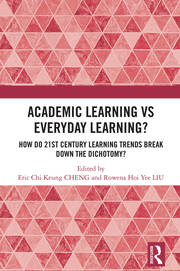
Academic Learning vs Everyday Learning? How do 21st Century Learning Trends Break Down the Dichotomy?
Part 1 – Introduction 1. Breaking the traditional academic and everyday learning dichotomy Part 2 – Approaches to break the dichotomy 2. Bridging theory and practice through dialogic collaborative inquiry and online discussion in teacher education 3. Nurturing pre-service teachers through scenario-based learning–case study: the Pamela Pack Discovery Space at Yew Chung College of Early Childhood Education 4. Medical problem-based learning within and beyond the classroom 5. Experiential learning as a powerful adhesive between academic and everyday learning Part 3 – Theory-practice integration across key learning areas 6. Unravelling the synergy: exploring the interplay between academic learning and everyday learning within the context of online social annotation 7. Revisiting the root of STEM in mathematics education 8. An experiential approach to learning and teaching science in a regional educational institution 9. AI literacy and the future of education 10. Micro-credentials in professional and vocational education: concepts, trends, and learner perceptions 11. Exploring financial decision-making among adolescents: an application of the theory of planned behaviour 12. Redesigning PSHE curriculum to bridge academic and everyday English as the medium of instruction: case studies of a university-school support programme in Hong Kong 13. Harmonising musical notes and life: the role of e-Orch in bridging academic music learning and everyday experiences Part 4 – Conclusion 14. Towards a unified vision of academic and everyday learning
Biography
Eric Chi Keung CHENG is the Vice President (Academic) of Yew Chung College of Early Childhood Education. He has initiated over 20 research projects in knowledge management and school improvement, and published over 90 international journal papers, book chapters, and ten academic books.
Rowena Hoi Yee LIU is a lecturer at the Faculty of Education, The University of Hong Kong. Her research interests include experiential life-wide learning, curriculum design, values, ethics, and spiritual education. She has been committed to various university-school partnership projects for curriculum development.
