




1st Edition
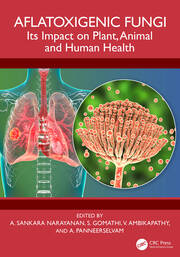
Aflatoxigenic Fungi Its Impact on Plant, Animal and Human Health
Section 1: OVERVIEW ABOUT AFLATOXIGENIC FUNGI IN PLANT, ANIMAL AND HUMAN HEALTH
Chapter 1.1 Overview and Sources of Aflatoxigenic Fungal Diversity in Plants
Priyanka Dahiya, Simran Rani, Chetna Rathi, Sai Prasad, A. Sankara Narayanan, Amita Suneja Dang, and Pooja Suneja
Chapter 1.2 Overview and Sources of Aflatoxigenic Fungal Diversity in Animals
Sanchita Choubey
Chapter 1.3 Overview and Sources of Aflatoxigenic Fungal Diversity in Humans
Vajiha Banu Habeeb Mohammed, A. Sankara Narayanan, and K. Anandhi
Chapter 1.4 Climate Change and Its Impact on Aflatoxigenic Fungi
Shruti Kharod, Samridhi Pushkarna, Kajal Gaba, Anil Kumar, M Veerapagu, K. R. Jeya, Pooja Suneja, and Amita Suneja Dang
Section 2: AFLATOXIGENIC FUNGI: IMPACT ON SOIL, PLANT, AND HUMAN HEALTH AND THE AGRICULTURAL ENVIRONMENT
Chapter 2.1 Aflatoxigenic Fungi and Their Ecology in Soil
Janet Jan-Roblero, Juan Antonio Cruz-Maya, José Mendoza-Figueroa, and Juan Carlos Cancino-Díaz
Chapter 2.2 Aflatoxins: Metabolic Interactions with Plants and Soil Biota
Chetna Rathi, Simran Rani, Priyanka Dahiya, Sankara Narayanan, Amita Suneja Dang, and Pooja Suneja
Chapter 2.3 Aflatoxigenic Fungal Impact on the Agricultural Environment : Sugarcane Field Soil
G. Sathvik, D.M. Yashaswini, and Lokesh Ravi
Chapter 2.4 Aflatoxigenic Fungal Impact on the Agricultural Environment: Rice Field Soil
S. Chaitanya Kumari, K. Deepak Raj, Mahesh Kedharashetty, and K. Anuradha
Chapter 2.5 Aflatoxigenic Fungal Impact on the Agricultural Environment: Peanut Field Soil
S. Shalini Devi, Manju Devi, and Prity Mishra
Chapter 2.6 Association between Aflatoxigenic Fungi and Plant Nutrition
I. Lavkor
Chapter 2.7 Aflatoxins in Plant Pathogenesis
Simran Rani, Anshu, Priyanka Dahiya, Chetna Rathi, A. Sankara Narayanan, Amita Suneja Dang, and Pooja Suneja
Chapter 2.8 Association between Aflatoxigenic Fungi and Plants
D.M. Yashaswini, G. Sathvik, and Lokesh Ravi
Chapter 2.9 Aflatoxigenic Fungi and Groundnut
Hamadou Mamoudou, Difo Voukang Harouna, Jairus Olumasai Nandwa, Vandi Yonas, and Martin Alain Mune Mune
Chapter 2.10 Aflatoxigenic Fungi and Tuber Crops
Harita Parmar and Roshini Patel
Chapter 2.11 Aflatoxin Fungi and Beverage Crops
Priyanka Dahiya, Simran Rani, Chetna Rathi, Vajiha Bhanu Habeeb Mohammed, Amita Suneja Dang, and Pooja Suneja
Chapter 2.12 Aflatoxigenic Fungi and Corn
I. Lavkor
Chapter 2.13 Aflatoxigenic Fungi and the Agricultural Economy
Yutika Narzary and S. Uma Devi
Chapter 2.14 Aflatoxigenic Fungi and Animal Feed
S. Meenakshi, R. Saravanan, S. Umayaparvathi, and Kumaran Subramanian
Chapter 2.15 Effect of Aflatoxins on Animals of Veterinary Interest
Mario E. Cancino-Díaz, Miguel A. De la Rosa-Ramos, Gabriel Betanzos-Cabrera, and Juan C. Cancino-Díaz
Chapter 2.16 Aflatoxigenic Fungi in fish and fish feed
Anandhi Anandaraj, Blessy Cleatus, Vaishnavi Thirukumaran, Maheswaran Solayappan, and Rajasekar Thirunavukkarasu
Chapter 2.17 Aflatoxigenic Fungi: A Challenge for Global Food Security
S. Umayaparvathi, S. Meenakshi, R. Saravanan, and Kumaran Subramanian
Chapter 2.18 Aflatoxigenic Fungi: A Global Concern for Food Safety and Human Health
Kajal Gaba, Samridhi Pushkarna, Shruti Kharod, Anil Kumar, Pooja Suneja, and Amita Suneja Dang
Chapter 2.19 Aflatoxigenic Fungi: Human Health Impacts and Control Methods
Samridhi Pushkarna, Kajal Gaba, Shruti Kharod, Anil Kumar, S. Uma Devi, Pooja Suneja, and Amita Suneja Dang
Chapter 2.20 Aflatoxigenic Fungi: Health Impacts in Infants and Children
G.R. Shree Kumari, V. Mohanasrinivasan, and Lokesh Ravi
Chapter 2.21 Aflatoxigenic Fungi: A Potential Human Carcinogen
Stanila Stoeva and Marieta Georgieva
Section 3: CONTROL OF AFLATOXIGENIC FUNGI
Chapter 3.1 Aflatoxigenic Fungi: Control by Nanomaterials
Nagashri Nanjundeshwara, Archana Lakshmaiah, and Ramya Raghavan
Chapter 3.2 Aflatoxigenic Fungi: Control by Plant Bioactive Metabolites
M. Veerapagu, K.R. Jeya, A. Sankara Narayanan, K. Aravinthan, Pooja Suneja, and Amita Suneja Dang
Chapter 3.3 Aflatoxigenic Fungi: Biological Control – An Overview
I. Lavkor
Section 4: ADVANCEMENT IN THE DETECTION OF AFLATOXIGENIC FUNGI
Chapter 4.1 Aflatoxigenic Fungal Communities and High-throughput Analysis
Liqian Du, Zhongkun Zhou, Yunhao Ma, Baizhuo Zhang, and Peng Chen
Chapter 4.2 Rapid Detection of Aflatoxigenic Fungal Communities in Agricultural Products
K. Ajith Kumar and Lokesh Ravi
Chapter 4.3 Detection of Aflatoxin by Surface-Enhanced Raman Spectroscopy (SERS)
José Silvestre Mendoza-Figueroa, Salvador Juan Acevedo-Gil, and Janet Jan-Roblero
Biography
Dr. A. Sankara Narayanan has been an Associate Professor in the Department of Life Sciences, School of Science, GSFC University, Vadodara of Gujarat state, India since July 2024. His current research focus is on microbiome studies, fermented food products, and environmental microbiology. He has published 20 books with different international publishers, 70 chapters, and 80 research articles in international and national journals of repute, guided 5 PhDs, 16 MPhil scholars, and operated 5 funded projects in microbiology. From 2002 to 2015, he worked as an Assistant Professor and Head, Department of Microbiology, K.S.R. College of Arts and Science, Tiruchengode, Tamil Nadu, and from August 2015 to May 2021 he was associated with Uka Tarsadia University, Surat, Gujarat, India. From June 2021 to June 2024 he worked as an Associate Professor and Head in the Department of Life Sciences, Sri Sathya Sai University for Human Excellence (SSSUHE), Kalaburagi, India. He has been awarded the Indian Academy of Sciences (IASc), National Academy of Sciences (NAS), and the National Academy of Sciences (TNAS) sponsored summer research fellowship for young teachers consecutively for three years, and his name is included as a Mentor in the DST-Mentors/Resource persons for summer/winter camps and other INSPIRE initiatives, Department of Science and Technology, Government of India, New Delhi. He is a grant reviewer for the British Society for Antimicrobial Chemotherapy (BSAC), UK. He is an active member of the editorial boards of various national and international journals. He is a Doctoral Committee member, Board of Study member in Microbiology in various colleges and universities in India, and a reviewer for many reputed international journals. One of his edited books received the Outstanding Academic Title (OAT) Award from an international publisher in 2020. This OAT Award represents the highest caliber of scholarly titles and overall excellence in presentation and importance relative to other literature in the field. His name was included in the World Scientists and University Rankings for 2023; this ranking list is released by AD Scientific Index.
Dr. S. Gomathi is an Assistant Professor in the Department of Botany and Microbiology, A.V.V.M. Sri Pushpam College (Autonomous), Poondi, Thanjavur District, Tamil Nadu, India. She has approximately 15 years of experience in teaching and research. Her area of specialization is mycology, medicinal plant diversity, and antifungal activity studies.
She has published more than 25 papers in internationally reputed journals and 15 chapters in books from internationally reputed publishers. She has guided 10 MPhil and 2 PhD scholars, and PhD scholars are working under her guidance now at Bharathidasan University, Tiruchirappalli, India. She is involved in the organization of various seminars and workshops, and acts as a resource person and participant in various workshops to enhance her research skills. She has filed and published two Indian patents. She is a life member of various professional and scientific bodies. She has participated in various orientation programs and shared her expertise with young students as a resource person.
Dr. V. Ambikapathy is an Associate Professor and Head, Department of Botany and Microbiology, A.V.V.M. Sri Pushpam College (Autonomous), Poondi, Thanjavur District, Tamil Nadu, India. He has 29 years of experience in teaching and research. He has specialized in the fields of mycology and plant pathology. He has visited the Udayana University, Bali, Indonesia. He received the INSA visiting scientist fellow award and has filed two patents.
He has deposited 92 gene sequences in GenBank, conducted 4 metagenome bioprojects, and maintains more than 500 microbial cultures in his laboratory. He is a reviewer for reputed journals and a doctoral committee member for more than 50 research scholars working at Bharathidasan University. He has published 149 research and review articles, 8 books, and 27 book chapters. He has guided 21 PhD scholars, 32 MPhil scholars, and organized several symposia, seminars, workshops, DST-INSPIRE programs for "plus one" students, YSSP programs, and so on. Dr Ambikapathy has conducted more than 50 training programs on edible mushroom cultivation technology for the welfare of women under a self-help group scheme. He has received several grants from various Indian funding agencies such as UGC-SERO, DST-INSPIRE, NMPB, UGC, and Tamil Nadu State Council for Science and Technology (TNSCST), India.
Prof. A. Panneerselvam, D.Sc., is an Associate Professor and Head (Retd), Department of Botany and Microbiology, A.V.V.M. Sri Pushpam College (Autonomous), Poondi, Thanjavur District, Tamil Nadu, India. He has 40 years of experience in teaching and research. His areas of specialization are mycology, plant pathology, and actinobacteriology. He has visited the National University of Singapore, Nanyang Technical University, TEMSEK Laboratory Singapore, Malaysian Agricultural University, Kuala Lumpur, Malaysia, Bangkok, Udayana University, Bali, Indonesia, the Institute of Fundamental and Applied Research, National Research University (TIIAME), Tashkent, Uzbekistan and also national-level institutes in India.
He has received 15 awards including INSA visiting fellowship, New Delhi; Member of Research Board of Advisors; Excellent Faculty award in Botany; Man of Year Commemorative Model; Life Time Achievement Award 2022; Senior Scientist Award 2023; and the MSI Fellow Award 2024. He has deposited 191 nucleotide sequences in GenBank, conducted 4 metagenome bioprojects, and maintains more than 500 microbial cultures in his laboratory. He is a reviewer for reputed journals and a doctoral committee member for 127 research scholars working at Bharathidasan University. He has published 476 research papers and review articles, 23 popular articles, and chapters in more than 12 books. He has guided 43 PhD scholars, 67 MPhil scholars, and organized several symposia, seminars, workshops, DST-INSPIRE programs for "plus one" students, the YSSP program, and so on. He has conducted more than 100 training programs on edible mushroom cultivation technology for the welfare of women under a self-help group scheme, Dissemination of Innovative Technology (DIT). He has received grants from various funding agencies such as the Department of Science and Technology (DST), the University Grants Commission (UGC), the Council of Scientific and Industrial Research (CSIR), the Tamil Nadu State Council for Science and Technology (TNSCST), the National Medicinal Plants Board (NMPB), and the District Rural Development Agency (DRDA). He is a life member of various academic bodies and an editorial board member of reputed journals. He trained a women's self-help group on edible mushroom cultivation technology under various schemes. He has been awarded a D.Sc. degree by the Periyar University, Salem, Tamil Nadu of India.
