




1st Edition
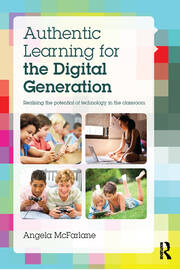
Authentic Learning for the Digital Generation Realising the potential of technology in the classroom
1. The digital learning landscape 2. Devices and desires 3. Public spaces 4. Collaborative Places 5. Solving problems, building knowledge 6. User generated content 7. Games and play 8. Thinking about writing 9. Manipulating data, seeing patterns 10. Looking to the horizon
Biography
Angela McFarlane has designed and directed a number of highly successful educational research and development projects over a 25-year period. Her development projects have resulted in a range of commercially successful products and reached schools across the world, with impact on learning documented through independent evaluation. She has been an adviser to governments in Europe, South America and South East Asia and the OECD and holds visiting chairs at King’s College, London and the University of Bath, UK. Angela is Chief Executive and Registrar of the College of Teachers.
'This is a timely bringing together of the key factors around technology enhanced learning. As policy makers are finally waking up to the potential for teachers to amplify their impact with technology, Angela McFarlane is rigorous in her approach to the debate. She successfully shows what works and what to look out for, and leads us to how the latest thinking can really transform teaching.'
Lord Jim Knight, Visiting Professor, London Knowledge Lab, UK
'Angela's book provides a fresh take on the core issues facing researchers and educators when integrating technology into the curriculum. She argues strongly that support for children's learning with technologies must go beyond an "if you build it they will learn" mentality. Her ideas for supporting learning with technologies have practical implications for parents and schools as well as important findings for academics and policy makers in designing for learning.'
Professor Danaë Stanton Fraser, Department of Psychology, University of Bath, UK
