




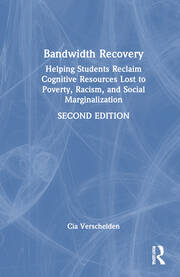

2nd Edition
Bandwidth Recovery Helping Students Reclaim Cognitive Resources Lost to Poverty, Racism, and Social Marginalization
Part 1: The Bandwidth Tax of Marginalization: Poverty, Racism, and Economic Inequality 1. Physical Health 2. Mental Health 3. Economic Inequality and Its Cost in Human Capacity 4. Available Cognitive Capacity – Bandwidth Part 2: Sociopsychological Underminers: Broken Connection 5. Childhood Trauma 6. Belonging Uncertainty 7. Stereotype Threat and Identity Threat 8. Human Connection 9. Focus on LGBTQ Students 10. Neurodiversity 11. Uncertainty: Existential Anxieties Part 3: Supporting Bandwidth Recovery 12. Trauma-informed/Asset-focused Practice 13. Belonging: Building Community/Intentional Connection 14. Decreasing Stereotype Threat and Identity Threat 15. Growth Mindset 16. Minimizing Uncertainty: Institutional Structures and Processes
Biography
Cia Verschelden has over 30 years of faculty, administrative, and student affairs experience at both two- and four-year public institutions. Most recently, she was a Special Projects Advisor at the Association of American Colleges and Universities and Vice President of Academic and Student Affairs at Malcolm X College in Chicago. She holds an EdD from Harvard University and an MSW from the University of Connecticut.
"Bandwidth Recovery was first published in 2017, just as I completed my term as President of Morehouse College. My only regret is that it was not published sooner, because I would have been armed with the perfect vocabulary and playbook for improving the living, learning and working environments for all students, faculty, and staff. It is now axiomatic – victims of systemic marginalization and “othering” pay a much higher bandwidth tax than most. Thus, any campus leaders who are determined to position everyone to optimize their skill sets, mindsets, and toolsets must read this book. And without even mentioning the current controversies, Verschelden provides the best way to clarify the value proposition of all offices devoted to diversity, equity and inclusion – that is, to lower the bandwidth taxes and restore the cognitive capacities of those with academic and life profiles that most warrant it. Rather than controversial, that is America at her best!"
John Silvanus Wilson, Jr., Managing Director of the Open Leadership Project at the MIT Media Lab, former President of Morehouse College, USA, and Author of Hope and Healing: Black Colleges and the Future of American Democracy.
