




1st Edition
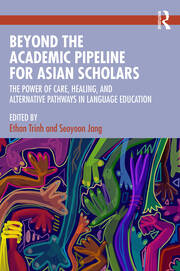
Beyond the Academic Pipeline for Asian Scholars The Power of Care, Healing, and Alternative Pathways in Language Education
Part 1: Foundations of Power, Care, and Belonging 1. Critical Reflections on Facing Pressures of Academia: Self-work, Mentorship, and Community 2. Challenging Reproduced Practices and Power Structures in Academy: One Teacher-Scholar’s Critical Autoethnography 3. Speaking Otherwise: Power, Pathways, and Possibility in Language Education Part 2: Practices of Solidarity, Becoming, and Healing 4. Rising: Duoethnography for Decolonial Academic Mentorship 5. Reimagining Support Systems for Asian-American Scholars: A Duoethnographic Account 6. Establishing Professional Identity through Exercising Agency: Asian Female TESOLers’ Doctoral Stories with Memory Writing 7. (Un)Silencing Liminal Identities Across Border Dreamscape: A Duoethnographic Study of Nepali Postgraduates Studying in the United States Part 3: Precarity and Alternative Pathways 8. Unmasking the Realities: Story of an Asian Mom Scholar in her Job Search journey 9. Breaking the Loop: A Narrative Inquiry of an International PhD Graduate in Academia 10. Examining Positionality and Building Community
Biography
Ethan Trinh (they/them) is Founder of Dr. Trinh’s Foundation, an Atlanta-based nonprofit advancing educational access, scholarships, and global learning opportunities for rural and multilingual communities in and beyond the United States. They also serve as Associate Director of the Atlanta Global Studies Center, a U.S. Department of Education Title VI National Resource Center at Georgia State University.
Seoyoon Jang, Ph.D. (she/her) is a teaching assistant professor of Korean in the Department of East Asian Languages and Literatures at the University of Pittsburgh.
"Such a raw and authentic contribution for Asian/American scholars navigating academic systems structured by hierarchy, rules, connections, and power. Ethan Trinh and Seoyoon Jang bring together a powerful collective of Asian/American voices who courageously share their lived experiences of surviving, disrupting, building solidarity, caring, and healing in spaces that often refuse to validate them. What emerges across these pages is a clear rejection of the myth of a linear academic journey. Instead, this volume powerfully reveals academic life as dynamic, relational, and deeply human. Through stories of precarity, resistance, mentorship, and collective care, the contributors challenge deficit narratives and reimagine scholarship as an act of solidarity and becoming. This book is not only a testament to resilience, but also an invitation to pause, to listen, and to envision more humane and just pathways for Asian/American scholars in and beyond the academy."
Khánh Lê, Queens College, CUNY
"What a much needed breeze of fresh air! This special collection unearths ‘the elephant in the room’ — self-care, felt emotion, job search, and power structure— that is usually less discussed, troubled, and published in normative academia. Editing with genuine care, Ethan Trinh and Seoyoon Jang bring together transnational Asian scholars and educators to generously share their first-hand lived experiences that expose the hard truth: there is more to the seemingly successful, ‘easy-peasy’, linear career pipeline than meets the eye. Indeed, the stories about the sacrifices, different forms of racial and linguistic discrimination, and emotional labours imposed on the Asian community should not and cannot be untold. We are pleased to see the editors and contributors (un)silence those marginalised voices and champion resilience, heritage knowledge, and critical love demonstrated by these transnational scholars of colour. Despite the current gloomy landscape, we find solace in the transformative power of care, healing and collegial support in a professional community of practice. We are stronger together."
Julian Chen, Curtin University, Australia
"This edited volume represents the care, healing and solidarity of a ‘becoming’ among Asian American scholars. The authors, all Asian identifying, have woven together their stories, illuminating how they negotiate their identities in relationship with one another, straining out the loud and Westernized constructs of the academy that situate them in peculiar and tangential ways. The co-constructed and co-analyzed experiences of the Asian American authors are represented by newer and emerging scholars who show what it means to be vulnerable, raw, and untethered; models that I wish I had as a young academic, often paralyzed by the fierce claws of academic being. Beyond Academic Pipeline for Asian Scholars: Power of Care, Healing, and Alternative Pathways in Language Education shows not a way of being, but a becoming. Within that becoming we learn how love, care and resilience are fostered communally. I see this book as a constant companion to Asian identifying students and colleagues who are embracing the ‘becoming’."
Trish Morita-Mullaney, Purdue University
"Beyond the Academic Pipeline for Asian Scholars offers a rare and deeply affirming space for rethinking what it means to inhabit, teach, research, learn, and dream as Asian scholars with intersectional identities in U.S. academia. The editors cultivate a tone of camaraderie and solidarity that is powerfully amplified through the reflective and critical narratives of Asian scholars across career stages. This volume invites readers in language education and related fields to interrogate linear, neoliberal academic trajectories and to imagine alternative ways of building meaningful scholarly lives and legacies. It speaks to doctoral students navigating “publish or perish” pressures, scholars facing an increasingly precarious academic job market, and those within the so-called ivory tower who continue to labor under relentless expectations of productivity. Rather than centering individual achievement, the book foregrounds relationality, community, mentorship, and care, making visible Asian identities too often rendered invisible in academia."
Jayoung Choi, Kennesaw State University, GA, USA
