




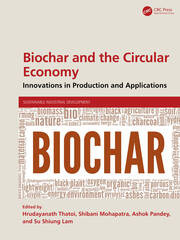
1st Edition
Biochar and the Circular Economy Innovations in Production and Applications
Section A: General
-
Introduction to biochar and circular economy
Shibani Mohapatra -
Mechanisms of action of biochar for agricultural and environmental applications
Ashutosh Pandey
Section B: Production of Biochar
-
Biochar production techniques and innovations
Cheong Kah Yein -
Production of biochar from agricultural residues
Su Shiung Lam -
Production of biochar from food waste
Wei-Hsin Chen -
Production of biochar from sewage sludge and municipal waste
Ashish N. Sawarkar -
Environmental impacts and sustainability of production of biochar
Hrudayanath Thatoi
Section C: Applications of Biochar
-
Agricultural applications of biochar
Hrudayanath Thatoi -
Application of biochar for removal of heavy metals from industrial wastewater
Kang Kang -
Application of biochar for removal of dyes from industrial wastewater
Rong-Hua Lee -
Application of biochar in anaerobic digestion for biogas production
Vivekanand -
Application of biochar in biohydrogen production
Lalit Kumar Singh -
Role of biochar in carbon sequestration and climate change mitigation
Sieng Huat Kong
Biography
Hrudayanath Thatoi serves as the Director of the Centre for Industrial Biotechnology Research at Siksha 'O' Anusandhan (Deemed to be University), Bhubaneswar, Odisha, India. His extensive academic portfolio includes 340 published research papers, 40 conference proceedings, and 63 book chapters. In addition, Prof. Thatoi has authored three textbooks and edited 22 books. He also holds three patents. One of his notable publications includes Effective remediation of Cr(VI) using coconut coir-derived porous biochar: application of kinetics and isotherm approaches. His research expertise includes lignin nanoparticles, nanocomposites, hybrid materials, and nano-biochar applications in bioremediation. He has also supervised numerous Ph.D. students in this field.
Shibani Mohapatra is an Assistant Professor (Research) at the Center for Biotechnology (CBT), Siksha 'O' Anusandhan University, Bhubaneswar. She earned her Ph.D. in Life Sciences from the National Rice Research Institute and North Orissa University, where her research focused on gene stacking for submergence tolerance, bacterial blight resistance, and yield improvement in the rice variety Swarna. Dr. Mohapatra has published 24 research papers in national and international journals. Her current research interests lie in Environmental Biotechnology and Plant Biotechnology.
Ashok Pandey is currently the Executive Director of the Centre for Energy and Environmental Sustainability-India, Lucknow. He previously served as a Distinguished Scientist at the Centre for Innovation and Translational Research, CSIR-Indian Institute of Toxicology Research, Lucknow, and as Chief Scientist and Head of the Centre for Biofuels at CSIR–National Institute for Interdisciplinary Science and Technology, Trivandrum. He holds several prestigious positions, including HTBS National Innovation Chair (Biotechnology), Distinguished Professor at UPES, Dehradun, and Distinguished Adjunct Professor at SIMST, Chennai. His primary research interests include industrial and environmental biotechnology, and energy biosciences, with a focus on biomass-to-biofuels and chemicals, and waste-to-wealth and energy conversion. Professor Pandey has also served as an Adjunct or Visiting Professor/Scientist at institutions in France, Germany, Brazil, Argentina, Mexico, Canada, China, South Korea, South Africa, Malaysia, Thailand, Switzerland, the USA, the UK, and others.
Su Shiung Lam is a tenured Professor of Universiti Malaysia Terengganu (UMT) in the Institute of Tropical Aquaculture and Fisheries, recognized as the Higher Institution Centre of Excellence (HICoE) for Sustainable Shellfish Aquaculture by the Ministry of Higher Education Malaysia. He is widely recognized for his significant contributions to Chemical and Environmental Engineering, particularly in the areas of sustainable technologies and waste utilization. His research expertise includes thermochemical processes, waste treatment, and biomass refinery, with a specialization in pyrolysis and microwave heating applications. He has secured 43 research grants, filed patents, and successfully commercialized innovations developed by his team. With over 560 published articles, Professor Lam is a highly cited researcher. He has received numerous national and international awards and is consistently ranked among the top 2% of scientists in his field, according to the Stanford University global rankings.
