





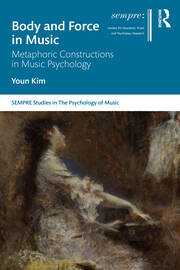
1st Edition
Body and Force in Music Metaphoric Constructions in Music Psychology
Introduction
The human body and musical instruments
Conceptual dimension of metaphoric construction
Force and agency
"Body and force" and "body versus force"
The discursive space and disciplinary identity of music psychology
Metaphors as shorthand for music psychology
Roadmap
Historicizing music psychology
Chapter 1. The Musicking Body-machine
Music, machine, and the body
The emergence of the "human motor" model
Rhythm: "an inevitable corollary from the persistence of forces"
Psychological studies in the era of rhythm
Musical rhythm and labor
Rhythm in the "body culture"
The "irrational," continuous rhythm
Rhythm and the piano-playing body
Concluding remarks
Chapter 2. "A Force of Nature": Tracing Voice
Animal, machine, and voice
Speech theory of music
Voice, the body machine, and the issue of agency
Voice as both object and subject
Voice of the "primitive" soul
Recorded Voice
"Dragging movement"
"How the voice looks"
Concluding remarks
Chapter 3. Motion, Force, and "Rhythm Form"
The "‘co-working of motion’ with one’s own will"
Piano theories
Motion in piano playing
Force and the will
The will, physiology, and piano-playing
Force and posture
Action–perception coupling at the turn of the twentieth century
"Rhythmic massing"
Concluding remarks
Chapter 4. Minding Gaps and Musical Energy
The ball analogy
The human motor capable of locomotion
Capturing the musicking body
Music as streams of energy
Gliding between tones
The agency of motion
Revisiting the ball analogy
Music as motion across disciplines and times
Concluding remarks
Chapter 5. Force at a Distance
Force acting at a distance
In the words of amateur pianists and psychologists
Force affecting the audience
The metaphor of vibratory waves in psychology
Force at a distance and The power of sound
"Brain waves" in communication
Inhibition and waves in music psychology
The vibratory energy of music
"Sympathetic oscillation"
Concluding remarks
Epilogue
Bibliography
Index
Biography
Youn Kim obtained her PhD in music theory from Columbia University and is currently Associate Professor of Music at The University of Hong Kong. Kim’s previous publications include a monograph History of Western Music Theory (2006) and articles in Journal of Musicology, Psychology of Music, and Journal of Musicological Research, among others. She also co-edited The Oxford Handbook of Music and the Body (2019) and co-authored several articles published in Scientific Reports and PLOS One.
What Kim presents in her "meta-psychology" of music is a story, circa 1900, in which music theorists and physiologists, economists and educators, physicists and philosophers create a whole new way of thinking about music—a musical thought that starts from the body and takes metaphors such as motion and force seriously. In this wide-ranging book, Kim shows how these discussions have not lost any of their relevance but strongly resonate with current musical concerns.
Alexander Rehding, Fanny Peabody Professor of Music, Department of Music, Harvard University
Youn Kim is one of the very few contemporary musicologists whose work is of true value to both historians of music as well as historians and philosophers of science. Her new book, Body and Force in Music: Metaphoric Constructions in Music Psychology captures the emergence of a complex new way of imagining music in the course of the rise of the new sciences of biology and human nature by psychologists and philosophers (Darwin, Spencer, William James) in the course of the late 19th century. Concepts such as "soul," "force," and "body" become at this time simultaneously scientific "facts" and powerful metaphors that shape an understanding of music as phenomenon and relocate the question of its social and cultural meanings. Youn Kim’s book offers a rethinking not only of what music means today but how it came to have such meanings. Any one engaged with discussions about music as a "scientific" or "social" phenomenon, ethnomusicologists and those engaged in post-colonial studies of music; any one captured by the idea that our musical minds both pre-determined by genetics and yet shaped by our environment, will benefit from reading Youn Kim’s seminal work.
Sander L. Gilman, Distinguished Professor of the Liberal Arts and Sciences and Professor of Psychiatry (Emeritus), Emory University; Author of "I Know Who Caused COVID-19": Pandemics and Xenophobia (2021)What exactly is music? Scientists have long wrestled with this question, often resorting to metaphors about movement, force, and the human body. In this well researched volume Professor Kim surveys the historical landscape that eventually becomes the modern field of music psychology. Along the way we are introduced to a singing sloth, a mechanical voice, and all manner of graphical representations as writers from previous centuries wrestle with the fleeting experience of music. The author brings together a chorus of fascinating voices—performers, critics, scientists, historians, dancers, neurologists—all grappling, as we still do today, with the mysteries of music.
Robert O. Gjerdingen, Professor Emeritus of Music Theory and Cognition, Northwestern University
