




1st Edition
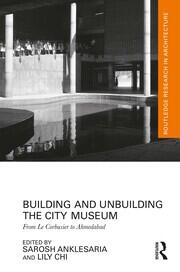
Building and Unbuilding the City Museum From Le Corbusier to Ahmedabad
List of Figures
List of contributors
Acknowledgments
Foreword by Vikramaditya Prakash
Introduction
A Walk through Sanskar Kendra
Sarosh Anklesaria
The Terms of Debate
Lily Chi
Dormant City Museum: A Photo Essay
Randhir Singh
Part One: Situating Sanskar Kendra: Histories and Context
1. Negotiating the Local and the Universal, the Client and the Architect at Sanskar Kendra
Daniel Williamson
2. Reading the Museum as Infrastructure: From the Mundaneum to Sanskar Kendra
Sarosh Anklesaria
3. Similarities and Differences of Le Corbusier’s Museums at Ahmedabad, Tokyo, and Chandigarh
María Cecilia O’Byrne
4. “Exposing” Concrete: The Constructional Legacies of the City Museum
Gauri Bharat and Mallika Nyshadham
Part Two: Critiques and Redirections
5. Ahmedabad: The Middle-Class Megacity
Mona Mehta
6. Sanskar Kendra: Re-membering the Cultural Center
Shubhra Raje and Riyaz Tayyibji
7. Reflections on the Making of the Bihar Museum and the Conflictorium
Batul Raaj Mehta and Avni Sethi
8. Sanskar Kendra Today: Is My Modernism Your Millstone?
Mrinalini Rajagopalan in conversation with Lily Chi and Sarosh Anklesaria
Part Three: Learning from Sanskar Kendra
9. Disarticulating Architecture
Lily Chi
10. Refractions on Sanskar Kendra
Lily Chi and Sarosh Anklesaria
11. B.V. Doshi on the Responsibilities of the Architect: A Conversation with Students
B.V. Doshi
Index
Biography
Sarosh Anklesaria is an Associate Teaching Professor and Track Chair of Carnegie Mellon University’s Master of Architecture program. Educated at CEPT University, Ahmedabad (Dip.Arch.), and Cornell University (M.Arch.), he has practiced in the United States, Switzerland, and India. His research and design advance architecture at the intersection of spatial justice and ecology in the built environment—recent projects address aging modernism in South Asia and architectures of just transitions in post- and deindustrializing contexts.
Lily Chi is an Associate Professor of Architectural Design, Theory, and History at Cornell University. She received her B.Arch. in Canada and her M.Phil. and Ph.D. in Architectural History and Theory at Cambridge and McGill Universities. Her current work examines the agency of built space as posed in post-war efforts to counter the effects of industrial capitalism on the urban everyday. Chi is co-editor of Seeding Urban Transformation (2026).
This volume of essays brings into critical focus the future of twentieth-century modern architecture in India. The essays illustrate the complex relationships between tangible and intangible realities that shape the spirit of our cities and inform our understanding of Indian urbanism.
Brinda Somaya, Principal Architect, Somaya Sampat; A.D. White Professor-at-Large Emerita, Cornell University; Founder Trustee: The HECAR Foundation
This book on Le Corbusier’s Sanskar Kala Kendra, more generally known as the Museum of Knowledge, in Ahmedabad, India, is a rare set piece of the type of interdisciplinary scholarship that brings into conversation architecture’s deeply situated nature.
Mark Jarzombek, Professor of the History and Theory of Architecture, MIT
Positioning Sanskar Kala Kendra metaphorically, the book expansively unpacks the disjunctures that aesthetic modernity as a proposition grappled with in a landscape where social and economic modernization remains an incomplete project—one now overrun by the tyranny of images circulating globally.
Rahul Mehrotra, John T. Dunlop Professor in Housing and Urbanization, Harvard University Graduate School of Design
A building as an indeterminate discourse, an architect as a provocateur, and a collection of essays thickening the brew, Building and Unbuilding the City Museum will become a critical compass in navigating the life of a civic building in shifting ideologies.
Kazi Khaleed Ashraf, Architect and architectural historian
A searing account of the complex process through which modern architecture is evolving into a form of archaeological knowledge. Sarosh Anklesaria and Lily Chi present a powerful framework that challenges us to reconsider whether—and how—this archaeological knowledge can be made relevant to the communities of the future.
Farhan Karim, Arizona State University
