




1st Edition
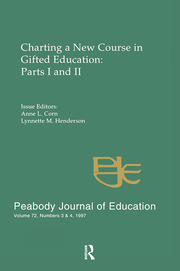
Charting A New Course in Gifted Education Parts I and Ii. A Special Double Issue of the peabody Journal of Education
256 Pages
by
Routledge
256 Pages
by
Routledge
256 Pages
by
Routledge
Also available as eBook on:
Highlighting the work of 17 distinguished national authors, this special issue suggests a new course for the field of gifted education -- one that emphasizes the individual and suggests that the focus of gifted education be dynamic and contextual. From legal perspectives to changing concepts of giftedness, talent, and assessement; from using new technologies to identify differences in brain... Read more
Volume 72, Numbers 3 and 4, 1997
Contents: Part I:Constructs and Philosophical Foundations. A.L. Corn, L.M. Henderson, Editors' Introduction to Part I. J.H. Borland, The Construct of Giftedness. C.M. CallahanThe Construct of Talent. L.K. Silverman, The Construct of Asynchronous Development. L. M. Henderson, F.F. Ebner, The Biological Basis for Early Intervention With Gifted Children. B. Clark, Societal Ideologies and Gifted Education in Today's Schools. R.F. Subotnik, P. Olszewski-Kubilius, Restructuring Special Programs to Reflect the Distinctions Between Children's and Adults Experiences With Giftedness. L.J. Coleman, Studying Ordinary Events in a Field Devoted to the Extraordinary. Part II:Educational Responses to Giftedness. L.M. Henderson, Editors'Introduction to Part II. S.K. Johnsen, Assessment Beyond Definitons. J.J. Gallageher, Least Restrictive Environment and Gifted Students. F.A. Karnes, R.G. Marquardt, The Fragmented Framework of Legal Protection for the Gifted. T.L. Cross, Psychological and Social Aspects of Educating Gifted Students. D.Y. For, J.L. Baytops, D.A. Harmon, Helping Gifted Minority Students Reach Their Potential: Recommendations for Change. N.M. Robinson, The Role of Universities and Colleges in kEducating Gifted Undergraduates. S.A. Reinisch, L. Reinisch, One Year at a Time: Parents' Perspective on Gifted Education.
Contents: Part I:Constructs and Philosophical Foundations. A.L. Corn, L.M. Henderson, Editors' Introduction to Part I. J.H. Borland, The Construct of Giftedness. C.M. CallahanThe Construct of Talent. L.K. Silverman, The Construct of Asynchronous Development. L. M. Henderson, F.F. Ebner, The Biological Basis for Early Intervention With Gifted Children. B. Clark, Societal Ideologies and Gifted Education in Today's Schools. R.F. Subotnik, P. Olszewski-Kubilius, Restructuring Special Programs to Reflect the Distinctions Between Children's and Adults Experiences With Giftedness. L.J. Coleman, Studying Ordinary Events in a Field Devoted to the Extraordinary. Part II:Educational Responses to Giftedness. L.M. Henderson, Editors'Introduction to Part II. S.K. Johnsen, Assessment Beyond Definitons. J.J. Gallageher, Least Restrictive Environment and Gifted Students. F.A. Karnes, R.G. Marquardt, The Fragmented Framework of Legal Protection for the Gifted. T.L. Cross, Psychological and Social Aspects of Educating Gifted Students. D.Y. For, J.L. Baytops, D.A. Harmon, Helping Gifted Minority Students Reach Their Potential: Recommendations for Change. N.M. Robinson, The Role of Universities and Colleges in kEducating Gifted Undergraduates. S.A. Reinisch, L. Reinisch, One Year at a Time: Parents' Perspective on Gifted Education.
Biography
Anne L. Corn, Lynnette M. Henderson
