




1st Edition
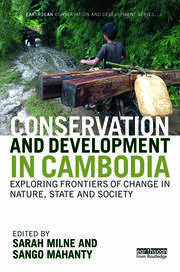
Conservation and Development in Cambodia Exploring frontiers of change in nature, state and society
1. The Political Ecology of Cambodia’s Transformation
Sarah Milne and Sango Mahanty
2. Shackled to Nature? The Post-conflict State and its Symbiotic Relationship with Natural Resources
Sarah Milne, Pak Kimchoeun, and Michael Sullivan
Part 1: Transformation, Complexity and Contestation in Nature-Society Relations
3. Lost in Transition: Landscape, Ecological Gradients and Legibility on the Tonle Sap Floodplain
Andrew S. Roberts
4. Can Market Integration Improve Livelihoods and Safeguard the Environment? The Case of Hybrid Rice Varieties in Cambodia’s Agricultural Heartland
Maylee Thavat
5. Land is Life: An Analysis of the Role ‘Grand Corruption’ Plays in Enabling Elite Grabbing of Land in Cambodia
Megan MacInnes
6. Contested Development and Environment: Chinese-backed Hydropower and Infrastructure Projects in Cambodia
Michael Sullivan
Part 2: Interventions in Natural Resource Management
7. Managing Protected Areas in Cambodia: The Challenge for Conservation Bureaucracies in a Hostile Governance Environment
Richard Paley
8. In Whose Name and in Whose Interests? An Actor-oriented Analysis of Community Forestry in Bey, a Khmer village in Northeast Cambodia
Robin Biddulph
9. The Forest Carbon Commodity Chain in Cambodia’s Voluntary Carbon Market
Sango Mahanty, Amanda Bradley and Sarah Milne
Part 3: Social Movements and Radical Responses to Transformation
10. What about the ‘Unprotected’ Areas? Building on Traditional Forms of Ownership and Land Use for Dealing with New Contexts
Jeremy Ironside
11. Cultures and Histories of Resistance in Cambodia
Margaret Slocomb
12. A ‘People’s’ Irrigation Reservoir on the Tonle Sap Floodplain
John Marston and Chhuon Hoeur
13. Story-telling and Social Change: A Case Study of the Prey Lang Community Network
Terry Parnell
Biography
Sarah Milne is a Postdoctoral Fellow in the Resources, Environment and Development group, Crawford School of Public Policy, College of Asia and the Pacific, Australian National University.
Sango Mahanty is an ARC Future Fellow in the Resources, Environment and Development group, Crawford School of Public Policy, College of Asia and the Pacific, Australian National University.
"Cambodia’s headlong 'development' since 1993 has given the country one of the highest growth rates in Asia. This clear-headed, disturbing and often poignant volume counts up the human and ecological costs of uncontrolled 'development', deforestation, land-grabbing, foreign intrusions and endemic corruption on Cambodia’s depleted landscape and on its distressed. resilient and long-suffering population." – David Chandler, Monash University, Australia.
"This is an important book, and not just for those interested in Cambodia’s environmental transformation. Empirically rich, it provides a powerful antidote to the comforting notion that economic growth can go hand-in-hand with environmental protection and this, in turn, with human development. Notwithstanding a few shards of hope, all-in-all this is a sobering volume that should be read by scholars, practitioners and officials alike." – Jonathan Rigg, National University of Singapore.
"This is a fascinating international politico-environmental study... The achingly turbulent history of Cambodia compels one to think fundamentally afresh about how to connect people, state, nature and culture. This book offers some hope and provides extraordinary insights." - Des Thompson, BES Bulletin.
"This book would benefit to a broad range of scholars and activists working on political and development issues in Cambodia and indeed anybody interested in the many and rapid ways the country is changing." - Neil Loughlin, Newsletter Of The Association Of Southeast Asian Studies In The United Kingdom, SOAS, School of Oriental and African Studies.
