



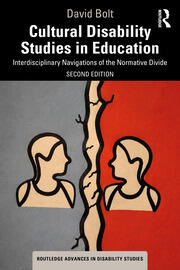
2nd Edition
Cultural Disability Studies in Education Interdisciplinary Navigations of the Normative Divide
Prologue. Non-normative Ontology: Social Aesthetics and Identity Pedagogics 1. Novel Thinking: Disability, Literature, and the Classic Forbidden Romance 2. Visions from the Yellow Decade: Disability, Aesthetics, and Residual Existence 3. From Sideshow to Cinema: Disability, Film, and Horrification 4. Remembering the Drowned and the Saved: Disability, Holocaust, and the Inadequacies of Representation 5. In the Log House: Disability, Gender, and Resistance to Social Norms 6. Stuff Happens: Disability, Happiness, and the Pursuit of Cure 7. End of the Rock Star: Disability, Music, and the Passage of Time 8. One of the Crowd: Disability, Humour, and the Contradictions of Comedy 9. On the Campaign Trail: Disability, Media, and Levels of Representation 10. Out of Touch: Disability, Radio, and Complex Otherness Epilogue. Disability and Disciplines: Learning, Teaching, and Reflecting
Biography
David Bolt is Director of the Centre for Culture and Disability Studies and Program Lead of the Disability Studies MA at Liverpool Hope University.
"In this revised edition, Professor Bolt captures the astonishing breadth of cultural sites where disability studies can do its work and bring its distinctive critical insights to life. Inciting conversations across literature, film, radio, and beyond, makes this book a captivating and essential resource for anyone interested in how disability is represented."
— Tanya Titchkosky, Social Justice Education, OISE of the Univeristy of Toronto."Bolt’s scholarly work contributes uniquely to the field of critical disability studies exploring representations of disability in ways which are important and relevant to scholars from a wide range of disciplines."
— Nicola Martin, Professor of Social Justice and Inclusive Education. Director of Building Future Communities Research Centre. Visiting Professor University of Northampton. Senior Fellow HEA, National Teaching Fellow and a Fellow of the RSA.Praise for the First Edition:
"David Bolt is one of the foundational scholars working in critical disability studies, and the clear and concise outline of disability and education here showcases his extensive knowledge of the field. Well-written, accessible, and with a wide range of examples from across disciplines, this book is essential reading for everyone working in the subject areas on which it focuses."
— Professor Stuart Murray, Director, Leeds Centre for Medical Humanities, University of Leeds"Though the book was composed in the UK, its use is broader. Bolt clarifies terminology for UK and US audiences, and the book will benefit an audience of students and newer scholars, as well, due to its extensive but focused use of core terminology (supported by a glossary of 17 key terms), the artful illustration of concepts, and the well-researched bibliographies at the end of each chapter. Overview of critiques and interpretations of the primary texts, of interdisciplinary fields, and of Disability Studies concepts (like embodiment, narrative prosthesis, Speech Act theory, and performativity (51)), are especially instructive."
— Disability Studies Quarterly 40:1 2020."The best thing about this book is that it can possibly inform and reform a seemingly limitless number of critical cultural conversations. In addition to the scholarly takeaways this book offers, however, is the potential for more community and relational equity in cultural learning environments by inviting cripistemology into the conversation, not just as a valid discourse, but as a guiding one."
— Journal of Literary and Cultural Disability Studies 14:1 2020.
