




1st Edition
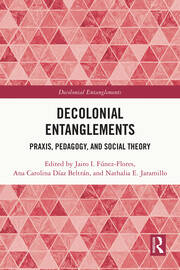
Decolonial Entanglements Praxis, Pedagogy, and Social Theory
Introduction
Jairo I. Fúnez-Flores, Ana Carolina Díaz Beltrán, and Nathalia E. Jaramillo
PART I: PRAXIS IN A TIME OF GENOCIDE AND SCHOLASTICIDE
1 Education Above the Rubble: Israel’s Scholasticide in Gaza
Samar Saeed and Juman Abujbara
2 Grief and Liberation: Decolonial Praxis in the Face of Genocide
Amanda Najib, Lila Sharif, and Amira Jarmakani
3 Teaching as Resistance: Towards an Abolitionist and Decolonial Praxis in University Education
Leila Mouhib
4 Decolonial Pedagogy and Praxis in a Time of Live-Streamed Genocide: Dialogic Notes from a Global North Classroom
Usha Iyer and Sophie D’Souza
5 Lessons from the UC Intifada Liberated Zone
Khirad Siddiqui
PART II: ENTANGLED STRUGGLES AND EPISTEMOLOGIES
6 A Roadmap to Self-Determination: Decolonial Feminisms in Puerto Rico
Aurora Santiago Ortiz and Joniel Pacheco
7 Pilipiniana as Anticolonial Theorizing From-Us-For-Us
Antonio Salvador M. Alcazar III, Maria Khristine Alvarez, Joshua Miguel Makalintal, and Andya Paz
8 Untethering the Youth Carceral State: Reorienting Toward Decolonial Educational Abolitionism Praxes
Brian Cabral and Monserat Vargas
9 Hemispheric Mexican-Origin Indigenous Campesino Struggles for Life
Tomás A. Madrigal
10 Transnational Encounters Among Educators and Movements: Toward Political and Pedagogical Possibilities Beyond Colonial and (Neo)Liberal Regimes
David Morales
11 Decolonial Feminisms as Border Thinking: A Genealogical Journey
Nathalia E. Jaramillo
PART III: POETICS OF REFUSAL AND WORLDMAKING
12 Once-children, Now Teachers: Theorizing Black and Indigenous Educator Care as Self-Defense
Anna Almore
13 Migrants’ Testimonios with/from Una Mirada al Sur
Freyca Calderon Berumen and Maure Carolina Aguirre Ortega
14 Storytelling and Spirals: (Re)membering, (Re)storying, and (Re)visioning for Collective Liberation and Refusal
Decoloniality Dialogues Collective
Biography
Jairo I. Fúnez-Flores is an Assistant Professor of Curriculum Studies at Texas Tech University. He is the Program Chair of the Decolonial, Postcolonial, and Anti-Colonial Studies in Education SIG for the American Educational Research Association. His research is situated at the intersection of sociocultural studies in curriculum theory, decolonial theory, critical ethnography, and social movement research. Currently, he is working on a book project focused on counterinsurgent and insurgent theory to situate thought in struggles for liberation. He has published articles in Theory, Culture & Society, Globalisation, Societies and Education, Sociology Compass, and Educational Studies. He is also the co-editor of the Bristol University Press book series Decolonization and Social Worlds, lead editor of the Routledge book series Decolonial Entanglements: Praxis, Pedagogy, and Social Theory, and lead editor of The Sage Handbook of Decolonial Theory.
Ana Carolina Díaz Beltrán is an Assistant Professor of Social Studies Education at the University of Texas Rio Grande Valley. Her research focuses on the living experiences of citizenship and belonging of transnational Latine youth, intergenerational schooling experiences of Black families in the US, and decolonial thought and praxis. She has published articles in Curriculum Inquiry, Theory & Research in Social Education, and Educational Studies.
Nathalia E. Jaramillo is Professor of Interdisciplinary Studies at Kennesaw State University in Atlanta, Georgia. She is the author of Immigration and the Challenge of Education (2012) and coeditor of Epistemologies of Ignorance in Education (2011) and Disrupting Colonial Pedagogies: Theories and Transgressions (2024). Her scholarship engages feminist, decolonial, and critical pedagogical frameworks to examine how knowledge, identity, and power are constructed and contested across educational and social contexts. Jaramillo has written extensively in the fields of critical educational thought and the politics of education. Across her teaching and writing, she seeks to cultivate spaces of epistemic justice and community-centered transformation within and beyond the academy.
