



1st Edition
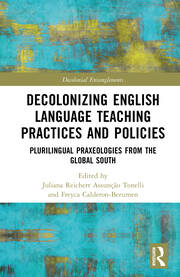
Decolonizing English Language Teaching Practices and Policies Plurilingual Praxeologies from the Global South
Introduction – Juliana Tonelli and Freyca Calderon Section I: Early Childhood and Primary Education (Early years to approx. 14 years old), Chapter 1: Decolonial Transdisciplinary Movements in Language Education in a Brazilian Public-School Context - Maria José Hoelzle and Rosane Rocha Pessoa Chapter 2: Decolonizing the English Language Curriculum for and with children: a borderless ontological proposal - Juliana Tonelli and Jaqueline Toneli Chapter 3: Translingualand Program: Opportunities of the Implementation of Translanguaging as an Alternative Pedagogy in Two Public Schools from Pereira, Colombia - Angélica Arcila Ramírez, Dany Andrés Hoyos Serna, and Sandro Alfonso Echeverry Palacio Chapter 4. Bridging the Gap: Local Appropriations of CLIL for Transformative Bilingual Education in a Public School in Barranquilla - Yeisy Molina-Siado and Nayibe Rosado-Mendinueta Section II: Secondary Education (approx. 15 to 19 years old) Chapter 5: The process of teaching and learning of English in the presence of the national bilingual plan in Colombia - Elcy Lucia Cañas Areiza and Iris Rubi Monroy-Velasco Chapter 6: Translanguaging and Critical Literacy as Pedagogies for Decolonial Co-Learning in Plurilingual Secondary Schooling Spaces – Kevin Donley Chapter 7: Between Policy and Practice: Challenging Colonial Assessment in High School Mexican and Brazilian Classrooms - Elsa Fernanda González and Gladys Quevedo-Camargo Section III: Higher Education (Post-Secondary) Chapter 8: Critical American Language Praxis in the US higher education – Magdalena Madany-Saa and Jason Litzenberg Chapter 9: Linguistic Policies in Higher Education: Between Global Standardization and Plurilingual Justice – Alina Martinez Hernández, Gabriela Jacqueline Galeas Arboleda and Jardel Coutinho dos Santos Chapter 10: Decolonizing Language Settlement Programs – Wanda Shell Chapter 11: Reflecting on Plurilingualism and Plurilingual Practices: English Language Education in the Interiors of Indonesian Archipelago - Dinny Risri Aletheiani Chapter 12: Teaching in the Tension of Coloniality: Critical reflexivity and Decolonizing Becoming in Teacher Education - Freyca Calderon Section IV: Decolonizing Language Policies Chapter 13: Can Translanguaging Help Decolonize Language Education? Interrogating the Role of Language Policy Reform - Nirda G. Derose, Karina Oliveira de Paula, Michelle Angelo-Rocha, and Robert Gonzaga Mukasa Chapter 14: Challenging Linguistic Racism and Classism: Paving the Way for Decolonial Language Policies in Colombia – Maure Carolina Aguirre Ortega Chapter 15: Social justice and interculturality in language teacher education: The case of a university context in Oaxaca - Jorge Valtierra-Zamudio, Vilma Huerta Cordova, and Mario E. López-Gopar Chapter 16: Policy Barriers and Bridges to Decolonial Praxis in Ecuadorian Intercultural Bilingual Education – Kevin Donley Chapter 17: A Transformative Proposal in Deaf Language Education: Translanguaging, Decoloniality and Social Justice in Dialogue – Cláudia Hilsdorf Rocha and Jéssica Vasconcelos Dorta Afterword - Sangeeta Bagga-Gupta
Biography
Juliana Reichert Assunção Tonelli She is an Associate Professor in the Department of Foreign Languages at Londrina State University, Brazil, where she teaches and supervises undergraduate and graduate students in teacher education and the Language Studies Programme. She is currently the Brazilian National Council for Scientific and Technological Development (CNPq) Productivity Fellow. Her main research interests are language teacher education and language education to young learners.
Freyca Calderon-Berumen is an Associate Professor in Elementary and Early Childhood Education and Women’s Gender and Sexuality Studies at Penn State University, Altoona College. Her research interests are interdisciplinary, exploring transnational issues of language, race, class, gender in educational settings. Her work privileges intersectionality and creates spaces for interdisciplinary de/colonizing and qualitative research where creativity and contemplative approaches are legitimized and seen as gateways for cultivating depth, integrity, expansive inquiry, and discovering critical insights linking theoretical perspectives with everyday experiences and developing culturally relevant understandings in the pursuit of equity.
