
1st Edition

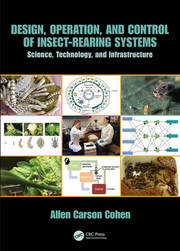
Design, Operation, and Control of Insect-Rearing Systems Science, Technology, and Infrastructure

By Allen Carson Cohen Copyright 2021
420 Pages 297 Color & 63 B/W Illustrations
by CRC Press

420 Pages 297 Color & 63 B/W Illustrations
by CRC Press

Design, Operation, and Control of Insect-Rearing Systems: Science, Technology, and Infrastructure explains the fundamental components of insect rearing: 1) the rearing systems, per se 2) personnel 3) education of rearing personnel 4) communication of procedures 5) an in-depth look at silkworm rearing 5) facilities where rearing is conducted, and 6) funding for all these... Read more
Approaches to Developing Rearing Systems, Creating an Algorithm for Developing or Problem-Solving Rearing Systems, Heuristics, and Reliable, Reproduceable Insect Production. Who Is Who in Insect Rearing?. Design and Operation of Insect Rearing Systems: Science, Technology, and InfrastructureSilkworm Rearing Systems. "Case Study of the USDA, ARS R. T. Gast BCMRRU:Boll Weevil and Lepidoptera Mass-Rearing". Rearing Systems as Ecological Niches or N-Dimensional Hypervolumes. Designing Error (Variability) Reduction in Rearing Systems: Reducing Uncertainty. Building a Process Control System. Tutorials on Using Design of Experiments with SAS, JMP Protocols. Relationships between Fitness, Quality Control, Health, Homeostasis, and Stress. Publishing Rearing Papers. Rearing Education: The Pathway to Improving Rearing Science and Technology. Future of Insect Rearing. Research Integrity in Insect Rearing Studies. Appendix 1. Appendix 2. Appendix 3. Appendix 4

Biography

Allen Carson Cohen completed his high school education in Chicago, Illinois and went to university in California for a BA and MA in English and a teaching credential. He later returned to college for an MA in biology, specializing in the physiological ecology of rattlesnakes. He completed his PhD in entomology at the University of California, Riverside (1978). He has served for seven years as editor for insect diets, insect rearing, and insect feeding biology for the Journal of Insect Science and serves as a mentor for students, researchers, and professionals in diet and rearing science and technology. He holds six U.S. patents, has published more than 125 refereed papers, and has received several technology transfer awards for his work on insect diets. He is currently research professor and coordinator of the Insect Rearing Education and Research Program at North Carolina State University, where he teaches online and in-person courses on insect rearing and conducts research on developing and improving insect rearing systems.
