




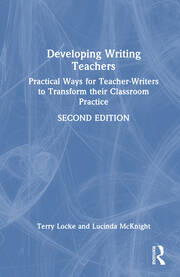
2nd Edition
Developing Writing Teachers Practical Ways for Teacher-Writers to Transform their Classroom Practice
Preface by Richard Andrews 1. Introduction Part I: The teacher as writer 2. Assuming the identity of a writer 3. Writing in the 21st Century 4. Writing the self through storying 5. Rhetors and resources: The democratic self in writing 6. Writing as enacting the professional self 7. Writing as design Part II: The teacher of writing 8. Best practice overview – what the research says 9. Building a community of writing practice 10. Writing as process 11. Addressing (and answering) the “grammar” question 12. Digital writing 13. Writing assessment as negotiating power and discourse
Biography
Terry Locke is Emeritus Professor of Arts and Language Education, The University of Waikato, New Zealand.
Lucinda McKnight is Associate Professor in the Faculty of Arts and Education and Australian Research Council DECRA fellow at Deakin University, Australia.
“This powerful, research-informed book places writing at the very heart of teaching by positioning teachers as writers themselves. It affirms that all students have something meaningful to say – and that with inspiration and thoughtful support, they can discover genuine pleasure in expressing it. Exploring what it means to claim and develop a writerly identity in the 21st century, it challenges narrow, standards-driven definitions of success and advocates for richer, more humanist approaches to writing pedagogy. Both reflective and practical, it is an empowering call for teachers to embrace writing not only as instruction, but as a vital part of who they are”.
- Debra Myhill FBA, Professor Emerita in Language and Literacy Education, University of Exeter
"What a needed book! Developing Writing Teachers is a concise, practical and critical synthesis of decades of research and practice from around the world and through all kinds of political and policy environments. What’s more, it has heart. If you want to know what really matters when it comes to equipping the best writing teachers possible, this book will show you".
- Anne Whitney, Professor of Education, Penn State College of Education
