
1st Edition

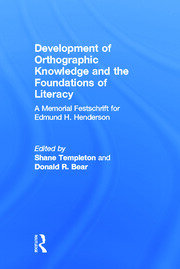
Development of Orthographic Knowledge and the Foundations of Literacy A Memorial Festschrift for edmund H. Henderson

Edited By Shane Templeton, Donald R. Bear Copyright 1992
384 Pages
by Routledge

384 Pages
by Routledge

384 Pages
by Routledge

This volume unites spelling and word recognition -- two areas that have largely remained theoretically and empirically distinct. Despite considerable advances in the investigation of processes underlying word perception and the acknowledgement of the seminal importance of lexical access in the reading and writing processes, to date the development and functioning of orthographic knowledge across... Read more
Contents: J. Deese, Foreword. E.H. Henderson, The Interface of Lexical Competence and Knowledge of Written Words. R.C. Schlagal, Patterns of Orthographic Development into the Intermediate Grades. D. Morris, Concept of Word: A Pivotal Understanding in the Learning-to-Read Process. J.T. Gill, The Relationship Between Word Recognition and Spelling. M.A. Invernizzi, The Vowel and What Follows: A Phonological Frame of Orthographic Analysis. D.R. Bear, The Prosody of Oral Reading and Stages of Word Knowledge. W.G.W. Barnes, The Developmental Acquisition of Silent Letters in Orthographic Images. J. Zutell, An Integrated View of Word Knowledge: Correlational Studies of the Relationships Among Spelling, Reading, and Conceptual Development. C.S. Beers, J.W. Beers, Children's Spelling of English Inflectional Morphology. S. Templeton, Theory, Nature, and Pedagogy of Higher-Order Orthographic Development in Older Students. M.P. Abouzeid, Stages of Word Knowledge in Reading Disabled Children. L.C. Ehri, Review and Commentary: Stages of Spelling Development. S. Templeton, D.R. Bear, A Summary and Synthesis: "Teaching the Lexicon to Read and Spell". F. Vellutino, Afterword.

Biography

Shane Templeton, Donald R. Bear

"...many of these chapters report more than one study, with the conclusions of one leading the author to another. Such follow-through presents an excellent model to future scholars, making this text important for doctoral students in language and literacy....I recommend this book to those studying emerging literacy (especially invented spelling) and disabled readers' ability to learn to read words."
Journal of Reading

"Virtually every chapter of this book begins, at least implicitly, with substantial observations from the classroom or clinic, and ends with inferences for teaching and intervention....This grounding in the real world recommends the book to those who train teachers and plan curricula, but it is also important to psychologists, at least those who would like their work to stay in contact with what really happens in schools, reading clinics, and homes every day."
American Journal of Psychology
