





1st Edition
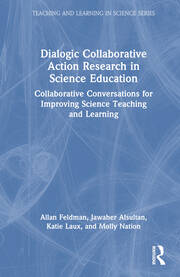
Dialogic Collaborative Action Research in Science Education Collaborative Conversations for Improving Science Teaching and Learning
1. Introduction to the Book 2. The Principles of Action Research 3. Introduction to Dialogic Collaborative Action Research (D-CAR) 4. Wicked Problems in Science Education 5. How to Implement D-CAR 6. Engaging in Conventional Action Research 7. Barriers to Implementing Action Research 8. Extending the Conversation -- Making D-CAR public 9. Cases of D-CAR 10. Afterword
Biography
Allan Feldman is Emeritus Professor of Science Education in the College of Education at the University of South Florida, USA.
Jawaher Alsultan is Assistant Professor of Curriculum and Instruction; Science Education in the College of Education at Imam Abdulrahman Bin Faisal University in Dammam, Saudi Arabia.
Katie Laux is Assistant Professor of Education at Upper Iowa University, USA.
Molly Nation is Associate Professor of Environmental Education in the Department of Ecology and Environmental Studies at Florida Gulf Coast University, USA.
"The authors, internationally diverse members of a Dialogic Collaborative Action Research (D-CAR) group, go beyond action research to discuss how D-CAR might be used to explore wicked problems in science education by creating, implementing, and engaging learning communities. [...]They encourage the use of student voice in research; the 3C+Q, Lingering Questions, and Epiphanies methods for expanding student engagement; and facilitators and critical friends to bring outside perspectives to the group. The text concludes with advice for extending D-CAR’s conversations for professional, personal, and political purposes; case studies on D-CAR applications in several nations; and the hope that D-CAR will be used by science teachers, science teacher educators, and others throughout the world."
-D. L. Stoloff, Eastern Connecticut State University, CHOICE
