




1st Edition
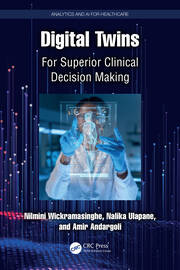
Digital Twins For Superior Clinical Decision Making
Part I: The Why of Digital Twins/Why Now
1. Decision-Making in Healthcare and the Rise of Technology and the Impact of the Digital Transformation
2. Digital Twins in Other Industries
3. The Case for Digital Twins for Healthcare
Part II: The What of Digital Twins
4. From Algorithms to Outcomes: Leveraging Machine Learning Clustering Techniques for Enhanced Clinical Decision Support
5. Clinical Decision Support through Federated Learning and Blockchain
6. From Algorithms to Outcomes: Leveraging Machine Learning Classification Techniques for Enhanced Clinical Decision Support
7. From Perceptron to Liquid Neural Networks: The Evolution of Neural Networks and Their Role in Black Box Modelling for Digital Twins in Healthcare
Part III: The How of Digital Twins
8. Digital Twins and Clinical Decision-Making
9. Application of Digital Twins in Healthcare Processes
10. The Impact of Blockchain and Digital Twins in the Pharmaceutical Industry
Biography
Nilmini Wickramasinghe is the Optus Chair and Professor of Digital Health at La Trobe University. She has been actively researching and teaching within the health informatics/digital health domain. In 2020, she was awarded an Alexander von Humboldt award for her outstanding contribution to digital health.
Nalika Ulapane is a researcher contributing to the design, development, and assessment of digital health solutions. He brings mathematical modelling, engineering systems design, and design science research principles to solve problems in complex systems like the healthcare sector.
Amir Andargoli focuses primarily on digitalization and digital transformation within the healthcare sector. He draws upon principles from information systems and management to conduct his research, which has resulted in publications in peer-reviewed journals and international symposiums.
"For decades, the digital representation of objects and entities has been a crucial field of research in computer science as well as application domains. Dynamic technological progress boosts the relevance by moving from modelling and instantiation towards realistically portrayed digital twins, e.g., by big data and artificial intelligence. Actually, the highest prospective impact of digital twins is anticipated in business and healthcare. Digital twins of products, machines, facilities and human beings will revolutionize the way we create value, for businesses as well as particularly for health providers and patients. This book is an eye-opener to that future."
Freimut Bodendorf, Professor, Friedrich Alexander University, Erlangen, Nuremberg, Germany
"Digital twins are increasingly relevant in the age of personalized medicine. Exploration of the effects of medicines avoids the potential of debilitating side effects and promotes individual health. This book can be expected to have a major impact."
Doug Vogel, PhD, AIS and AIDH Fellow
"This book could not have come at a more opportune time. As providers struggle to raise clinical quality, lower costs, and accomplish this with fewer human resources, technology can help achieve this. Although NASA launched the digital twin effort, the time has come for it to land in healthcare."
Duane F. Wisk, DO, MPH, FACOEM, Adjunct Assistant Professor, Warren Alpert School of Medicine, Brown University
"Digital Twins offers an innovative approach to modern healthcare delivery, where timely decision-making depends on numerous data sources, many of which are available in real time. This book provides a comprehensive overview of Digital Twin applications in healthcare, offering valuable insights for researchers, practitioners, and decision-makers interested in harnessing this technology to enhance healthcare delivery."
Wenny Rahayu, PhD, Professor and Dean of the School of Computing, Engineering and Mathematical Sciences, La Trobe University
