




1st Edition
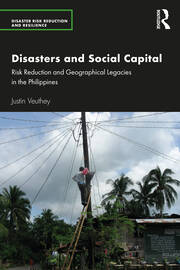
Disasters and Social Capital Risk Reduction and Geographical Legacies in the Philippines
Foreword
Chapter 1: Introduction and conceptual framework
Chapter 2: Asia and the Philippines
Chapter 3: Uncohesive reins of greed
Chapter 4: The Eastern Visayas
Chapter 5: The fulcrumic municipal scale
Chapter 6: Barangays
Chapter 7: Conclusions on inequalities, social capital, and DRR
Bibliography
Biography
Justin Veuthey is an associate researcher at the University of Geneva’s Institut de Recherches Sociologiques. He also worked as a journalist and with the Swiss government’s humanitarian aid agency.
"In Disasters and Social Capital, Justin Veuthey weaves a riveting narrative that explores the complex interplay between natural hazards, social capital, and economic inequality.
A remote municipality of the Philippines exposed to regular typhoons, earthquakes, and landslides provides the vivid backdrop for the powerful examination of how historical, political, and socio-cultural forces shape the dynamics of disaster preparedness and resilience. Through this lens and from different geographical levels, the book reveals how social capital is both a resource and a source of exclusion, and how vulnerabilities are intricately tied to local governance systems and economic structures.
This book is a vital contribution to the growing fields of Disaster Risk Reduction (DRR) and Climate Change Adaptation (CCA), offering crucial insights for those engaged in bridging the science-policy-practice divide. More than just a scientific study, it deepens our understanding of how intersectional vulnerabilities—shaped by class, ethnicity, and political power—compound vulnerabilities to natural hazards. Equally important, the book illuminates the ways in which local communities and institutions are building the capacities necessary to navigate these challenges and forge more resilient futures.
For students, scholars, disaster risk management practitioners, policy makers, and anyone seeking to understand the complexities of climate change, inequality, and resilience in an era of overlapping crises, this book is an indispensable resource. It is essential reading for those who wish to make a meaningful impact in a world struggling with the dual challenges of environmental and social crises, exacerbated by the deepening political and economic divides."
Emma Estenzo Porio, Professor Emeritus, Ateneo de Manila University; National Resilience Council, Philippines; President, Asia Pacific Sociological Association, 2020-2024
