





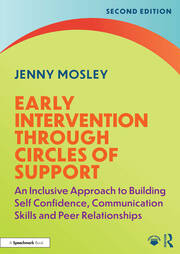
2nd Edition
Early Intervention Through Circles of Support An Inclusive Approach to Building Self Confidence, Communication Skills and Peer Relationships
Acknowledgements
Foreword
Preface
Introduction
1. What is happening in schools?
2. Dysregulated Children?
3. Linking waves of support and educational thinking
4. Introducing Circles of Support for children ‘beyond’
5. Planning your Circle of Support
6. What happens in a Circle of Support?
7. Plans for preliminary sessions to develop basic social skills
8. Five-step session plans
9. Two case studies incorporating Circles of Support
10. Other projects that support children ‘beyond’
11. Looking after yourself and your colleagues
12. Assessing, evaluating and monitoring progress
13. Resources
Appendix 1: Behavioural support for everyone through the Quality Circle Time model
Appendix 2: Wave-3 support and beyond
Biography
Jenny Mosley is the founder of Jenny Mosley Training Consultancies and originator of the highly acclaimed ‘Quality Circle Time Model’ that is used in thousands of Early Years settings, primary and secondary schools, nationally and internationally. Her unique approach has featured on BBC Television Teaching Today, Channel 4 and Open University programmes, in addition to the national press and numerous education journals.
“This is a brilliant book. It is positive, accessible and theoretically underpinned. As Jenny points out, schools are currently supporting an increasing number of children with complex needs… This book therefore is a valuable resource for educators who need practical strategies for supporting children’s social, emotional and mental health needs. It provides educators with a vast number of sessions which they can pick up and use with minimal preparation. The book’s strength is its accessibility, plus the numerous checklists which are provided to support self-evaluation and reflection. At a time when there is a significant challenge to school budgets, this resource offers a low-cost/high impact suite of interventions for educators who need to provide additional support for children beyond that of quality-first teaching.” - Professor Jonathan Glazzard, Rosalind Hollis Professor of Education for Social Justice, University of Hull, UK
