




1st Edition
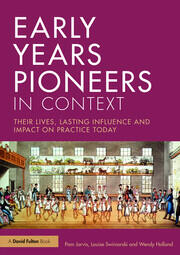
Early Years Pioneers in Context Their lives, lasting influence and impact on practice today
1. An Introduction to Early Years Pioneers in Context 2. Early Years Pioneers: In the Beginning 3. Frederick Froebel and the "Garden of Children" 4. Elizabeth Peabody (1804-1894): Implementing Froebel’s Play Based Learning 5. Susan Blow, Funding Kindergartens and Training Professionals for American Kindergartens in Public Education: (1843-1916) 6. Rudolf Steiner: The Anthrosophical Approach 7. Margaret McMillan: The Original ‘Liberatory Pedagogue’ 8. Maria Montessori: Scientific Pedagogy 9. Susan Isaacs: A Message in a Bottle 10. Loris Malaguzzi: Liberatory Pedagogy for Democracy
Biography
Pam Jarvis is a chartered psychologist and a historian. She is a Senior Lecturer at Leeds Trinity University, and her key research focus is the development of social policy for children, young people and their families. She has 20 years of experience of creating and teaching developmental, social science and social policy modules for Education/Child Development programmes in higher education.
Louise Swiniarski is a Professor Emerita in the School of Education at Salem State University, Massachusetts, USA, where she currently directs the Northeast Global Education Center to promote global literacy in Massachusetts’ schools and educators’ professional development programs.
Wendy Holland is involved in the mentoring, training and assessing of early years teachers at Bradford College, UK. She is also currently working in the Teaching, Health and Care sector at Bradford College, developing and producing modules for the BA (Hons) in Early Years Studies.
"At a time when early years practice in England appears increasingly shaped by political agendas, it is refreshing to read a book that reminds us that it does not necessarily have to be this way. In true pioneering spirit, Jarvis, Swiniarski and Holland take us on a journey of discovery through the contribution of notable historical figures associated with the early years from the beginning of the nineteenth until the end of the twentieth century."
Philip Selbie, Institute of Education, Plymouth University
