




1st Edition
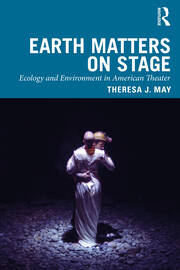
Earth Matters on Stage Ecology and Environment in American Theater
Acknowledgements
Preface From Ecotheatre to Ecodramaturgy
Introduction Where Has Theater been while the World’s been Falling Apart?
Chapter 1 Stories that Kill ~
The Frontier as Ecological Ethos in Augustin Daly’s Horizon
and William F.Cody’s Wild West: The Drama of Civilization
Chapter 2 Sabine Wilderness ~
David Belasco’s The Girl of the Golden West
and William Vaughn Moody’s The Great Divide
Chapter 3 Dynamos, Dust and Discontent ~
Eugene O’Neal’s Dynamo, and the Federal Theatre Project’s Living
Chapter 4 We Know We Belong to the Land ~
Rogers and Hammerstein’s Oklahoma! and Arthur Miller’s Death of a Salesman
Chapter 5 (Re)Claiming Home ~
Lorraine Hansberry’s Raisin in the Sun; Luis Valdez’ Bernabé;
Sam Shepard’s Buried Child
Chapter 6 Stories in the Land / Legacies in the Body ~
Robert Schenkkan’s The Kentucky Cycle; Cherríe Moraga’s Heroes and Saints;
Anne Galjour’s Alligator Tales
Chapter 7 Kinship, Community and Climate Change ~
Marie Clements’ Burning Vision and Chantal Bilodeau’s Sila
Epilogue Theater as a Site of Civic Generosity
Index
Biography
Theresa J. May is the author of Salmon Is Everything: Community-based Theatre in the Klamath Watershed , the co-editor of Readings in Performance and Ecology , the co-author of Greening Up Our Houses , and the co-founder and artistic director of the EMOS Ecodrama Playwrights Festival. She is an associate professor of theater at the University of Oregon.
'Every passionate page of this book and each of its illuminating readings of the ecotheatrical American canon that it unearths, critiques, and celebrates, are deeply rooted in Theresa May’s fierce loyalty to – and decades-long leadership of – the American eco-theater movement. Her firm grasp of the vital connection between story-telling and policy making, alongside her inspiring conviction that the theatrical imagination is an ecological force, makes her exposition of "eco-dramaturgy" as practically valuable as it is theoretically rigorous. Equally importantly, the book’s historical range makes it a rare contribution to the urgent task of reckoning with the culturally embedded, deep-structural causes of the climate crisis. It is hard to imagine a more timely or a more ground-healing work in our field today.'
Una Chaudhuri, New York University
