





1st Edition
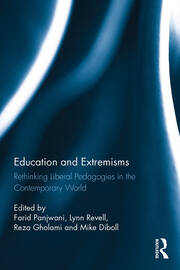
Education and Extremisms Rethinking Liberal Pedagogies in the Contemporary World
Foreword
Acknowledgements
List of Contributors
Introduction (Farid Panjwani, Lynn Revell, Reza Gholami and Mike Diboll)
Section 1. State Policies and Educational Practices
1. Challenging Extremism and Promoting Cohesion: National Policies and Local Implementation (Joyce Miller)
2. Education, Freedom of Belief and Countering Terrorism: The Minefield between UK Policy and School Implementation (Angela Quartermaine)
3. Education and Disengagement: Extremism and the Perception of Muslim Students (Tania Saeed)
4. Street Children, Integrated Education and Violence in Northern Nigeria (Chidi Ezegwu, Adewole O. Adedokun and Chioma Ezegwu)
5. Misplaced Utopia: Education and Extremism - the Case of Pakistan (Farid Panjwani and Zulfiqar Khimani)
Section 2. Perspectives on Extremism
6. Challenging the Legitimacy of Extremism: Critique through Education in the Work of Khaled Abou El Fadl (Angus M. Slater)
7. Teaching Early Muslim History: Facilitating Criticality through a Source-based Approach (Philip Wood)
8. ‘Mine Own Familiar Friend...’ Education and Extremism, within Historic Culture (John A. White)
9. Gender Equality in Education, Context and Criticality: Student Teacher Engagements in Three Northern Nigerian States (Elaine Unterhalter, Chidi Ezegwu, Adewole O. Adedokun, Mulika Lamido Dodo and Wadata Dangaladim)
10. The Balanced Nation: Addressing the Challenges of Islamist and Far-Right Extremism in the Classroom (Justin Crawford, Julia Ebner and Usama Hasan)
11. Multiple Ontologies of Extremism: ISISes in Education, a Case Study (Mike Diboll)
Section 3. Reconceptualising Liberal Education and Criticality
12. Negotiating Difference in Educatoin: Extremism, Political Agency and an Ethics of Care (Sarah V. Marsden)
13. Resilience and Soft Power: an Analysis of UK Government and International Guidelines and Resources to Address Radicalisation and Extremism in Education. (Lynn Revell)
14. Promoting Tolerance to Schools in a Time of Extremism (Robert A. Bowie)
15. Nurturing Critical Thinking across Self-Other Dichotomies (Daryoush Mohammad Poor)
16. Cosmopolitanism as Transformative Experience: Towards a New Social Ethic (Reza Gholami)
Epilogue (Mike Diboll, Lynn Revell, Reza Gholami and Farid Panjwani)
Biography
Farid Panjwani is a Senior Lecturer and founding Director at the Centre for Research and Evaluation in Muslim Education (CREME) at the UCL Institute of Education, University College London, UK.
Lynn Revell is Reader in Religion and Education at Canterbury Christ Church University, UK.
Reza Gholami is Lecturer in Sociology of Education in the School of Social Science and Public Policy at Keele University, UK.
Mike Diboll is Honorary Research Associate at UCL Institute of Education, University College London, UK.
"This book brings clarity and criticality to a complex and vitally important question: how can education prepare educators, school children and university students to live as revitalised active citizens? A strong team of thinkers and practitioners contextualise their proposals for action within a national and international framework. They challenge existing state ideologies and insist upon the capacities of education to teach us how to understand that pervasive truths may be provisional, that good education explains but may not resolve dissonant views and that tolerance must be active and critical. I recommend this book very warmly for its conceptual analyses and practical solutions to the labour of being critical, liberal and democratic."
Alison Scott-Baumann, Centre of Islamic Studies SOAS
