




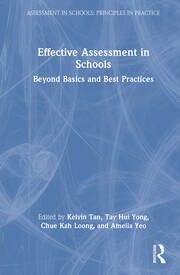
1st Edition
Effective Assessment in Schools Beyond Basics and Best Practices
Part 1: Assessment Fit for the Future in Schools, for Society
1. Preservice Teachers’ Conceptions of Fairness in Classrooms, Schools, and Society
Amirhossein Rasooli and Michael Holden
2. Assessment in an Inclusive Classroom
Simon Reynolds
3. Assessment for Student Wellbeing and Learning
Jill Willis and Julie Arnold
4. A Review of Singapore’s Assessment Reforms and their Impact in Reshaping and Repositioning Assessment Practices in Schools
Wong Hwei Ming and Kelvin Tan
Part 2: Assessment Literacy and Leadership
5. Assessment Leadership: What? How? By Whom?
Tay Hui Yong
6. Re-conceptualising Assessment Literacy: Situated Perspectives on Practice and Leadership
Durka Devi Palaraju
7. Resistance and Agency in Assessment for Learning
Kelvin Tan, Durka Devi Palaraju, Grace Koh, and Lin Shaojie
8. Evaluating the Influence of Leadership in Formative Assessment Implementation Across Two Primary Schools in Singapore
Kiren Kaur
9. Engaging Students as Feedback Partners in Singapore Schools: Affordances and Constraints
Jessica To and Grace Koh
Part 3: Theories and Technicalities of Assessment
10. Principled Assessment Design for Schools
Chue Kah Loong
11. A Critical Assessment of the Argument-based Validity Framework
Vahid Aryadoust and Azrifah Zakaria
12. Assessment in the Digital Age
Tay Hui Yong and Ralph Saubern
13. Supporting Assessment with Learning Progressions
Chue Kah Loong, Kate Lafferty, and Melissa Barnes
14. Item Response Theory and The Rasch Model
Qianqian Pan
Part 4: Assessment for all Learners in Schools and Society
15. Fostering Trust in Generative Artificial Intelligence - Assisted Asssessment for Learning Feedback: Exploring the Intersection of Teachers’ and Students’ Literacies in Feedback and AI
Shamini Thilarajah, Farhan Ali, and Shanti Divaharan
16. English Language Teachers’ Conceptions of Assessment Feedback: From Inspection To Introspection
Rachel Goh
17. Recognising Students’ Gestures as Signs of Learning for Formative Assessment
Amelia Yeo and Fei Victor Lim
18. Assessment for All (Special) Learners and the Lundy Framework of Participation
Xie Huichao and Kelvin Tan
19. Using the Receptivity to Instructional Feedback Scale in Primary and Secondary Schools
Anastasiya A. Lipnevich, Koh Ee Hway, Poh Lee Siew, Emilian A. Lipnevich, Edna Tay Chee Joo, and Kelvin Tan Heng Kiat
20. Assessment Fit for our Future—Beyond Practices and Paradigms to Protect Human Agency
Kelvin Tan
Biography
Kelvin Tan is Associate Professor in the Department of Learning Sciences and Assessment, National Institute of Education, Nanyang Technological University, Singapore.
Tay Hui Yong is Adjunct Senior Fellow in the Department of Learning Sciences and Assessment, National Institute of Education, Nanyang Technological University, Singapore.
Chue Kah Loong is Senior Lecturer in the Department of Psychology and Child & Human Development, National Institute of Education, Nanyang Technological University, Singapore.
Amelia Yeo is Assistant Professor in the Department of Psychology and Child & Human Development, National Institute of Education, Nanyang Technological University, Singapore.
"Effective Assessment in Schools is one of the most compelling and comprehensive collections on assessment available. With must-read articles by leading scholars, it pushes our thinking and practice forward, strengthening assessment in today’s schools".
Christopher DeLuca, Professor, Faculty of Education, Queen’s University, Canada
"Effective assessment is fundamental to student learning. This edited volume offers a comprehensive treatment of different aspects of assessment in Singaporean education and beyond. A stimulating read for researchers, teachers, and graduate students".
David Carless, Professor, Faculty of Education, University of Hong Kong, Hong Kong.
"Several decades ago the first edition of Rowntree's book, titled Assessing students: How Shall We Know Them? was published in 1977, with many reprints to follow. It provided an essential foundation for me as I began teacher preparation and remained a valuable text in changing times. I expect this exciting new volume, grounded in Effective Assessment in Schools: Beyond Basics and Best Practices will be also very highly valued by beginning teachers and those advancing their teaching journey. There is much to learn through the chapters as they come together in an impressive volume. It is undoubtedly a book for today's classrooms in the digital era. I am confident that the volume will be well received by beginning teachers and those continuing their learning about the centrality of assessment to learner growth. I expect it will simulate not only individual learning but will also trigger new insights into the nature and function of assessment, how it is enacted, and becomes situated in policy, and practice".
Claire Wyatt-Smith, Professor Emeritus, Australian Catholic University, Brisbane, Australia.
